
The tuna auction at Toyosu Market is the world’s largest of its kind, and for many visitors it’s the main draw. It offers a rare chance to see top-grade tuna inspected and sold at wholesale, but actually watching the auction is not as straightforward as it sounds.
I’ve attended the tuna auction multiple times from the public viewing windows, from closer up at the lottery-only observation deck, and as part of a guided tour.
In this guide, I explain what the auction is really like, how the lottery works in practice, and the different ways you can view it, so you can decide which option makes the most sense for you.
Toyosu Market Tuna Auction: Quick Links
- Is the Toyosu Market Tuna Auction Worth Seeing?
- What Actually Happens at the Toyosu Tuna Auction
- Two Ways to Watch the Toyosu Tuna Auction
- How to Enter the Tuna Auction Lottery
- Comparison: Observation Deck vs Public Viewing Windows
- Which Option Is Right for You?
- Seeing the Tuna Auction on a Guided Tour
Is the Toyosu Market Tuna Auction Worth Seeing?
Whether Tokyo’s tuna auction is worth seeing depends on your personal preferences and trip goals.
For me, the tuna auction is 100% worth attending for many reasons:
- Japan’s rich seafood heritage — I want to experience Japan’s exceptional seafood culture, and Tokyo’s tuna auction is a significant part of it
- From Tsukiji to Toyosu — my first visit to Toyosu Market’s tuna auction was partly motivated by seeing how it differed from the previous auction at Tsukiji Market, which I’d also attended
- Food markets — I’m drawn to food markets for their energy and bustle, and for the way they offer a direct window into local people and culture
- I love ōtoro (fatty tuna) — ōtoro sashimi and sushi are among my favourite dishes in Japan, and seeing bluefin tuna up close feels like a pilgrimage
- Food Tours Japan — as the founder of Food Tours Japan, I naturally gravitate towards Japan’s culinary culture, and visiting Toyosu Market and the tuna auction feels essential
- Early-morning Tokyo — being out in Tokyo at dawn, when the city is quiet and just waking up, is a unique experience
- Rarity of access — very few places in the world allow public viewing of auctions and the wholesale process at the top end of the seafood industry
- Massive scale — seeing rows upon rows of tuna and witnessing the sheer scale of the world’s largest tuna auction is striking
- Japanese work culture — while living in Japan, the professionalism, efficiency, and attention to detail of its work culture always impressed me, and you see it clearly here
- Sashimi and sushi — you’ll eat tuna across Japan, and the auction helps put how it ends up on your plate into context
This article will help you decide whether the tuna auction — and its early start — is right for you.
Let’s start with what it is and why you might want to attend.
What Actually Happens at the Toyosu Tuna Auction
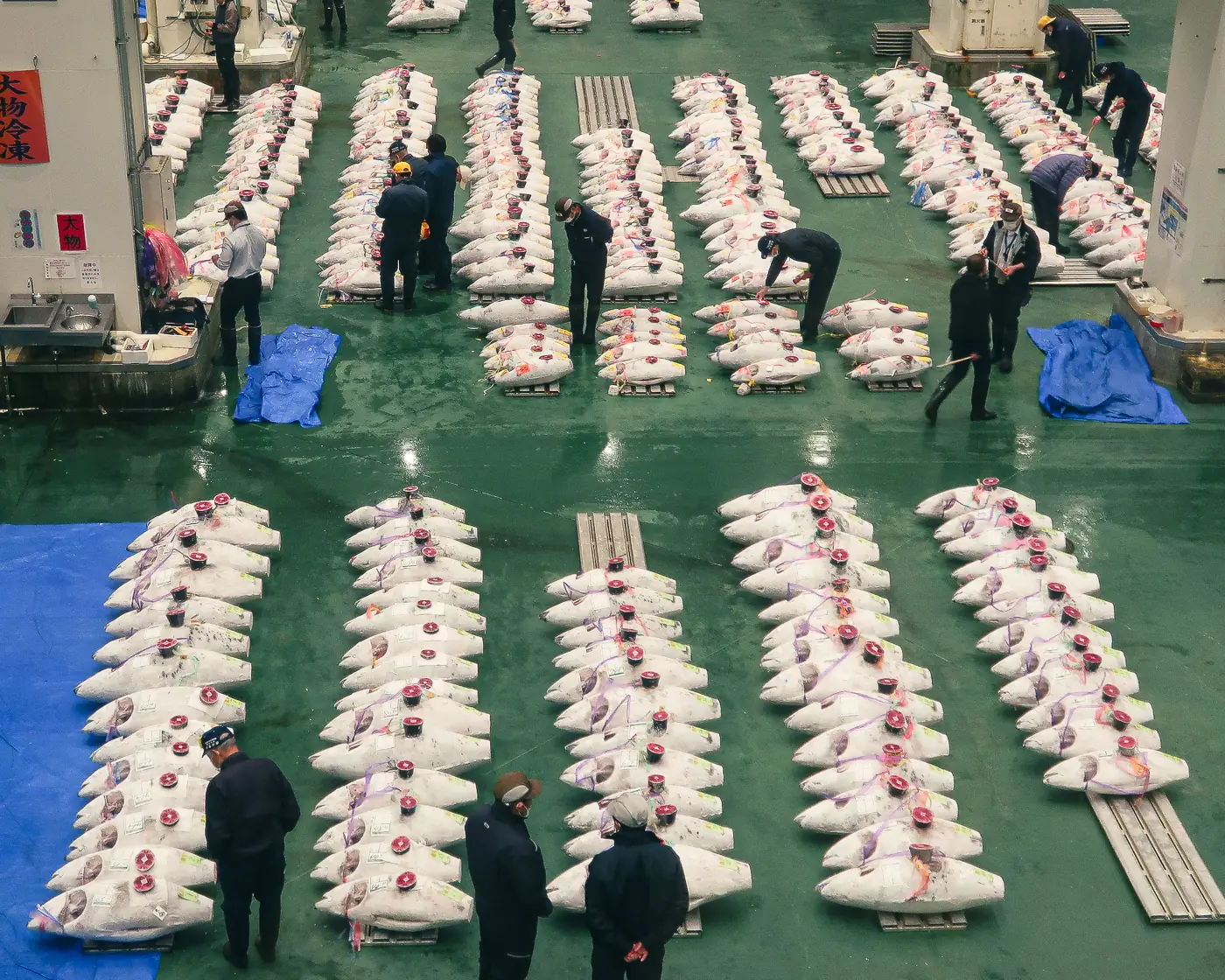
Toyosu Market is home to the world’s largest and most famous tuna auction. Each day, roughly 200 fresh tuna and around 1,000 frozen tuna, sourced from Japan and overseas, are sold to licensed buyers.
After the auction, the fish are either processed elsewhere in the market and distributed to sushi restaurants and retailers across Japan or sold through wholesale channels domestically and internationally.
Types of tuna and auction prices
The Toyosu auction sells five types of tuna: Pacific bluefin, Atlantic bluefin, Southern bluefin, bigeye, and yellowfin.
The most sought-after tunas are Pacific bluefin and Atlantic bluefin. Pacific bluefin are known in Japan as hon-maguro, meaning ‘true tuna’. However, the term can also refer to Atlantic bluefin due to their high culinary value.
Generally, bluefin tuna sell for between ¥8,000 and ¥10,000 per kilogram, but prices can reach ¥20,000 and, in exceptional cases, as high as ¥100,000. Fresh tuna commands prices twice to five times higher than those of frozen tuna.
Various factors can cause prices to fluctuate wildly, including:
- Quality of the tuna at inspection – fat content, colour and overall condition
- Market dynamics and seasonality – including supply levels and demand from top buyers
- Location of the catch – influenced by the fish’s diet, water temperature and migration patterns
- Catching and handling the tuna – particularly by specialised Japanese longline boats with exceptional handling
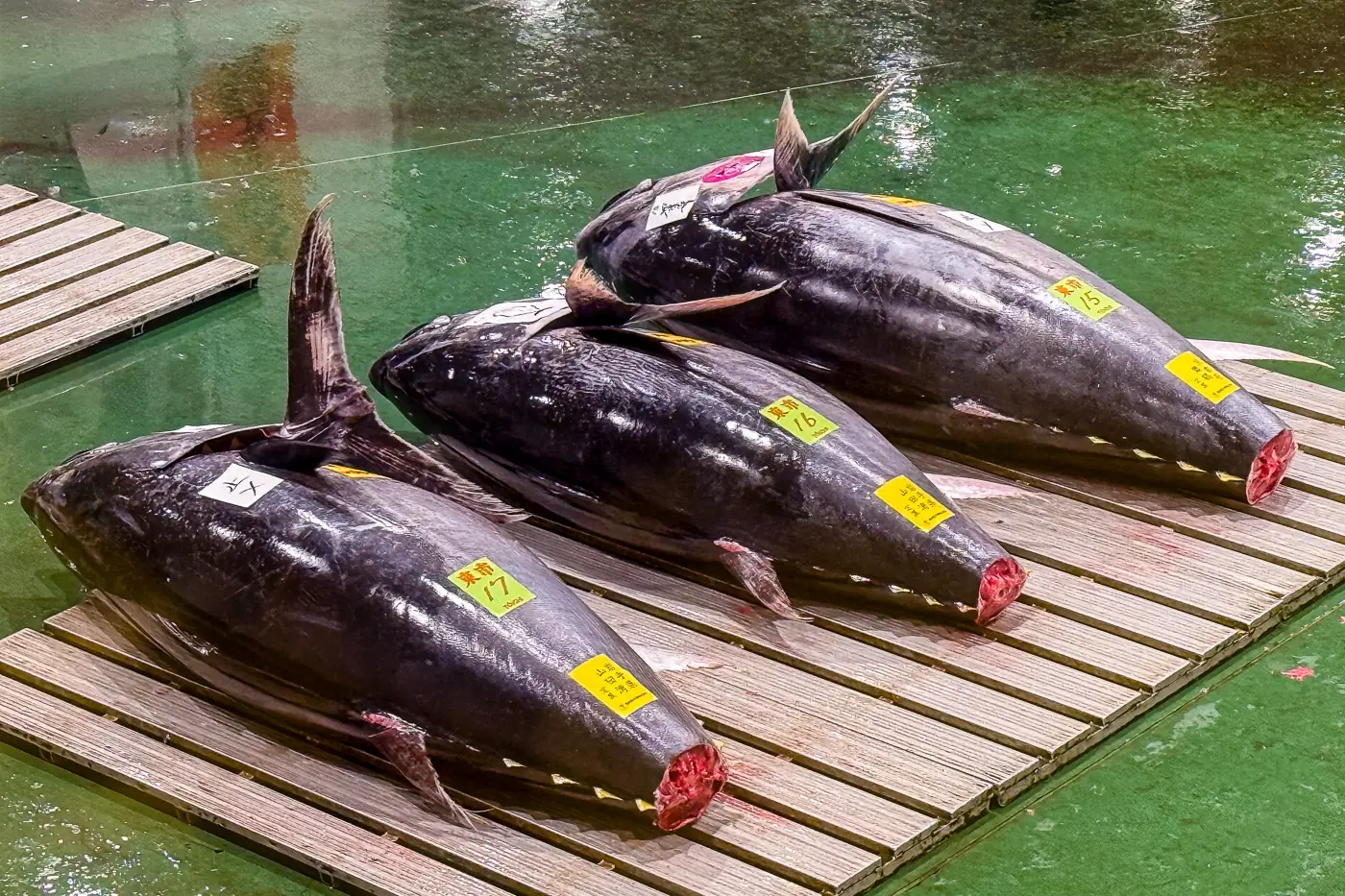
Ōma maguro: ‘black diamonds of the sea’
The most prized bluefin tuna in Japan are caught off the coast of Ōma, in Aomori Prefecture, at the northern tip of Honshu. The town sits on the Tsugaru Strait, where the Pacific Ocean meets the Sea of Japan and multiple currents converge, creating rich feeding grounds for bluefin tuna.
Combined with Japan’s highly refined bluefin fishing and handling techniques, Ōma bluefin—often referred to as the ‘black diamonds of the sea’—regularly command the highest prices at Toyosu’s tuna auction.
World’s most expensive bluefin tuna
At Tokyo’s first New Year auction in 2026, a 243kg Ōma bluefin sold for a record ¥510.3 million (around $3.2 million).
The buyer was Kiyoshi Kimura, often dubbed the “tuna king,” and the owner of Sushi Zanmai, a major sushi restaurant chain in Japan. Widely seen as a publicity exercise rather than a reflection of everyday market prices, Kimura described the purchase as symbolic, saying that ‘the year’s first tuna brings good luck.’
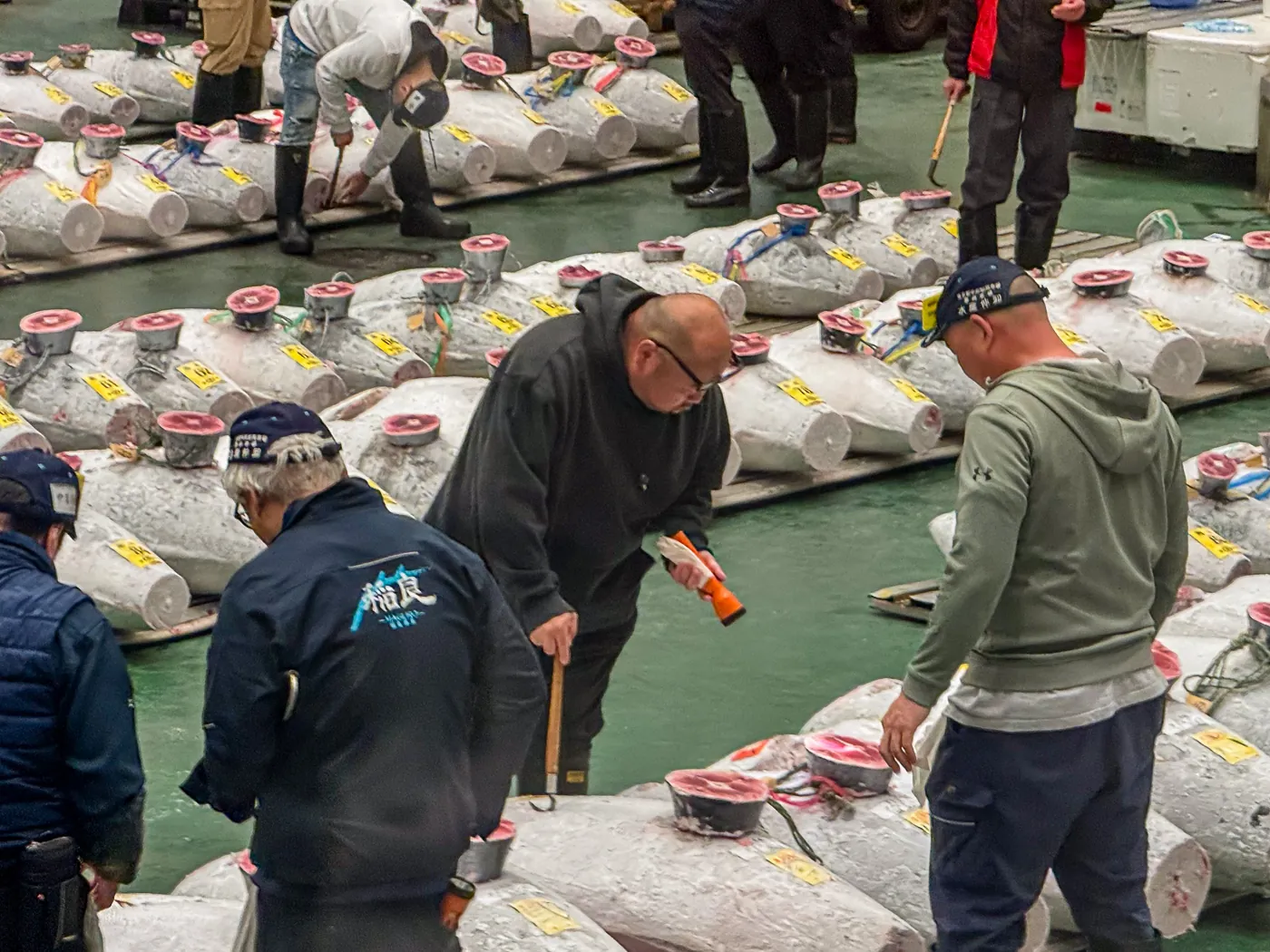
Tuna inspection
From the time Toyosu Market opens to the public at 5am, you can watch buyers inspecting the tuna ahead of the auction. It’s worth arriving early to see this part of the auction, as watching the inspections gives you a much better sense of how it all works. And after all, if you’re already up at that hour, arriving 30–45 minutes earlier is well worth it.
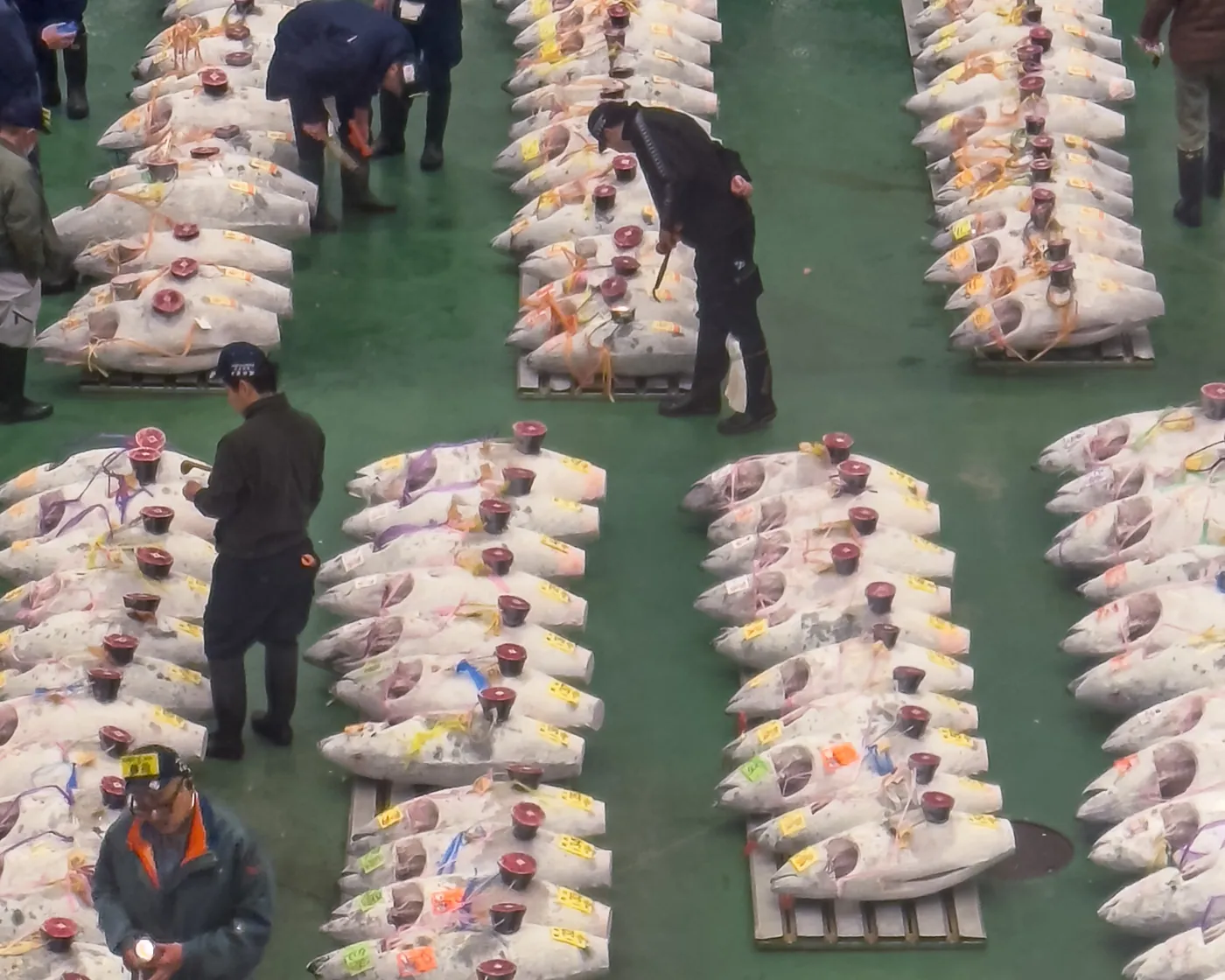
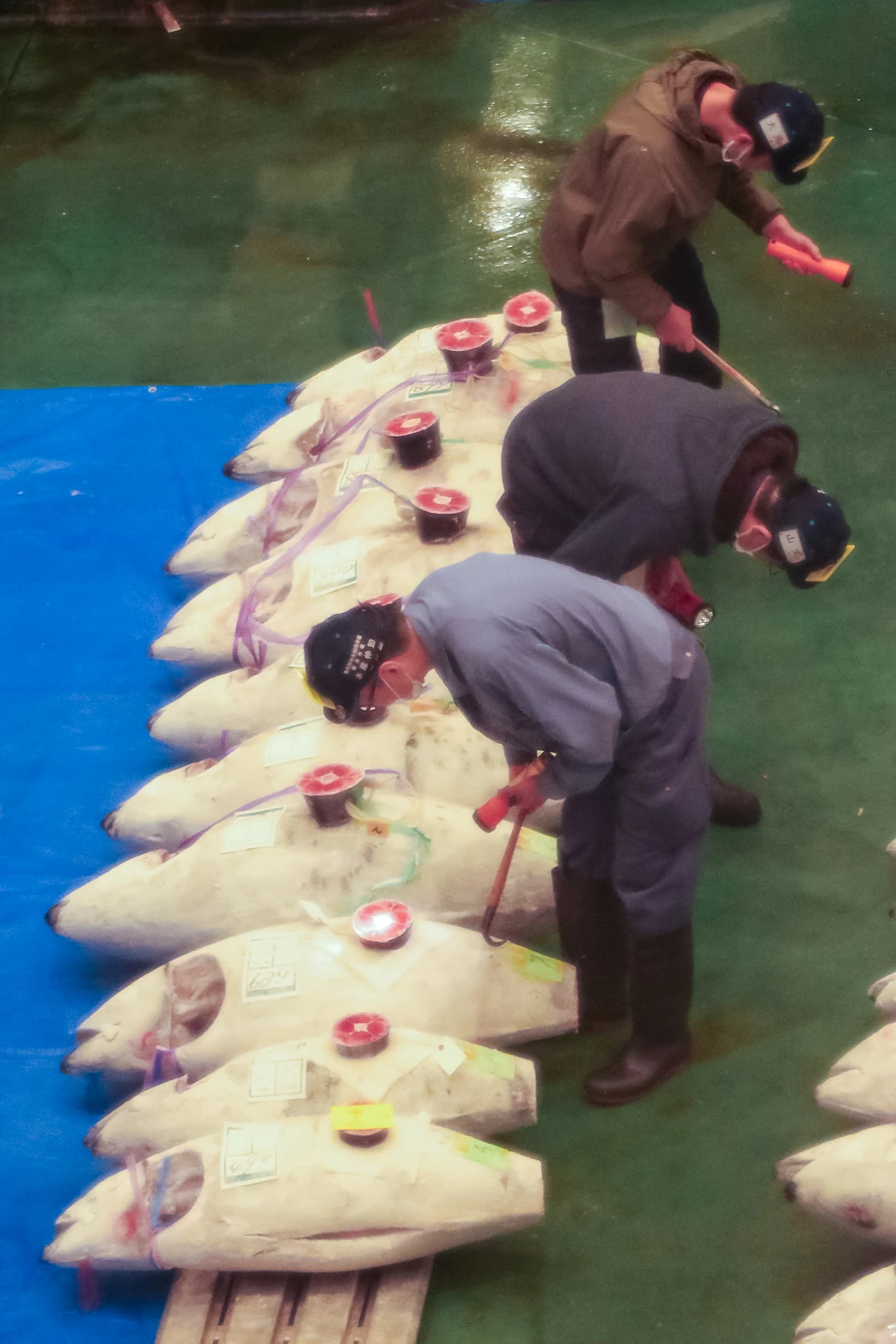
It feels like the calm before the auction storm, as buyers quietly and meticulously inspect the tailless tuna.
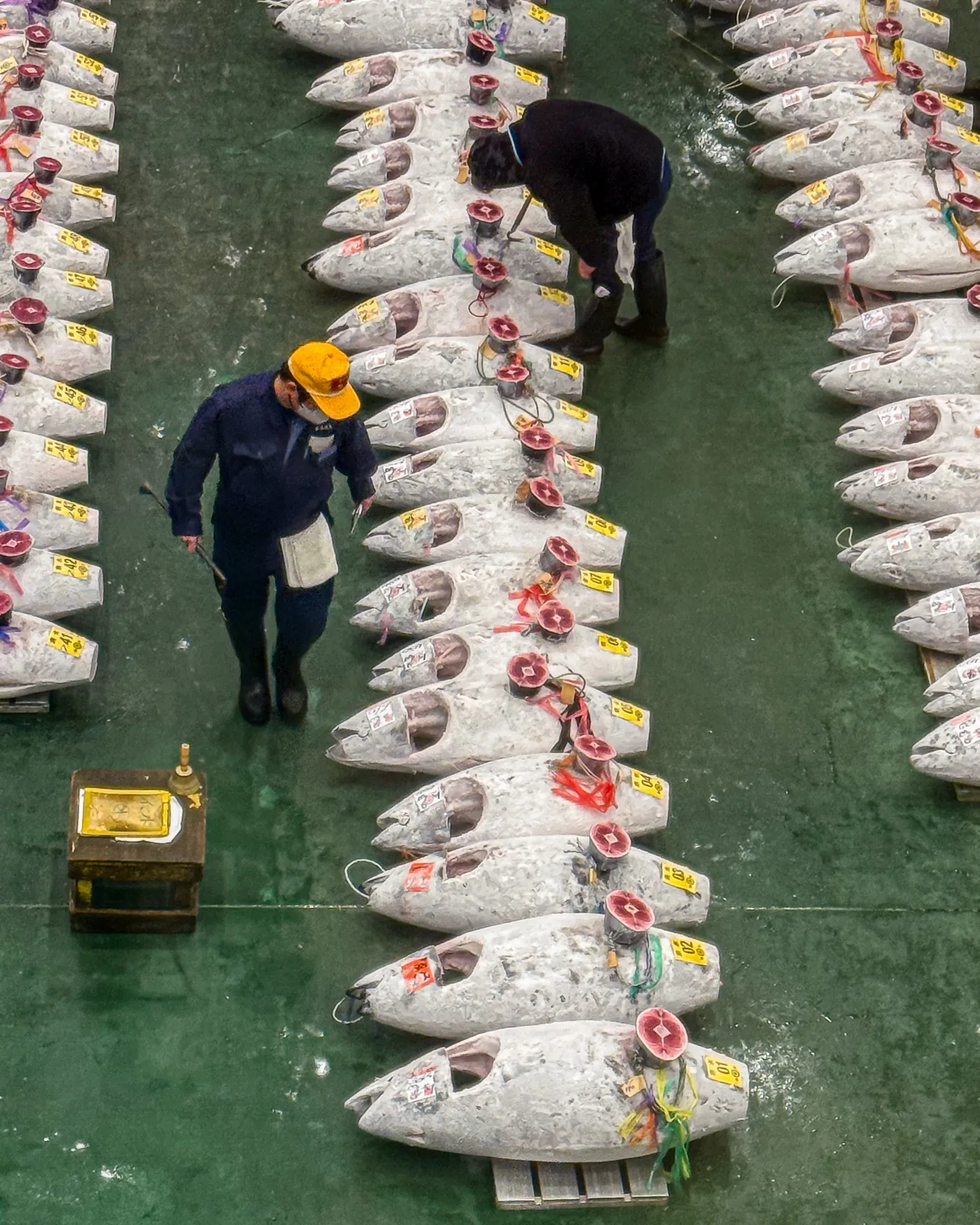
How the tuna inspection process works
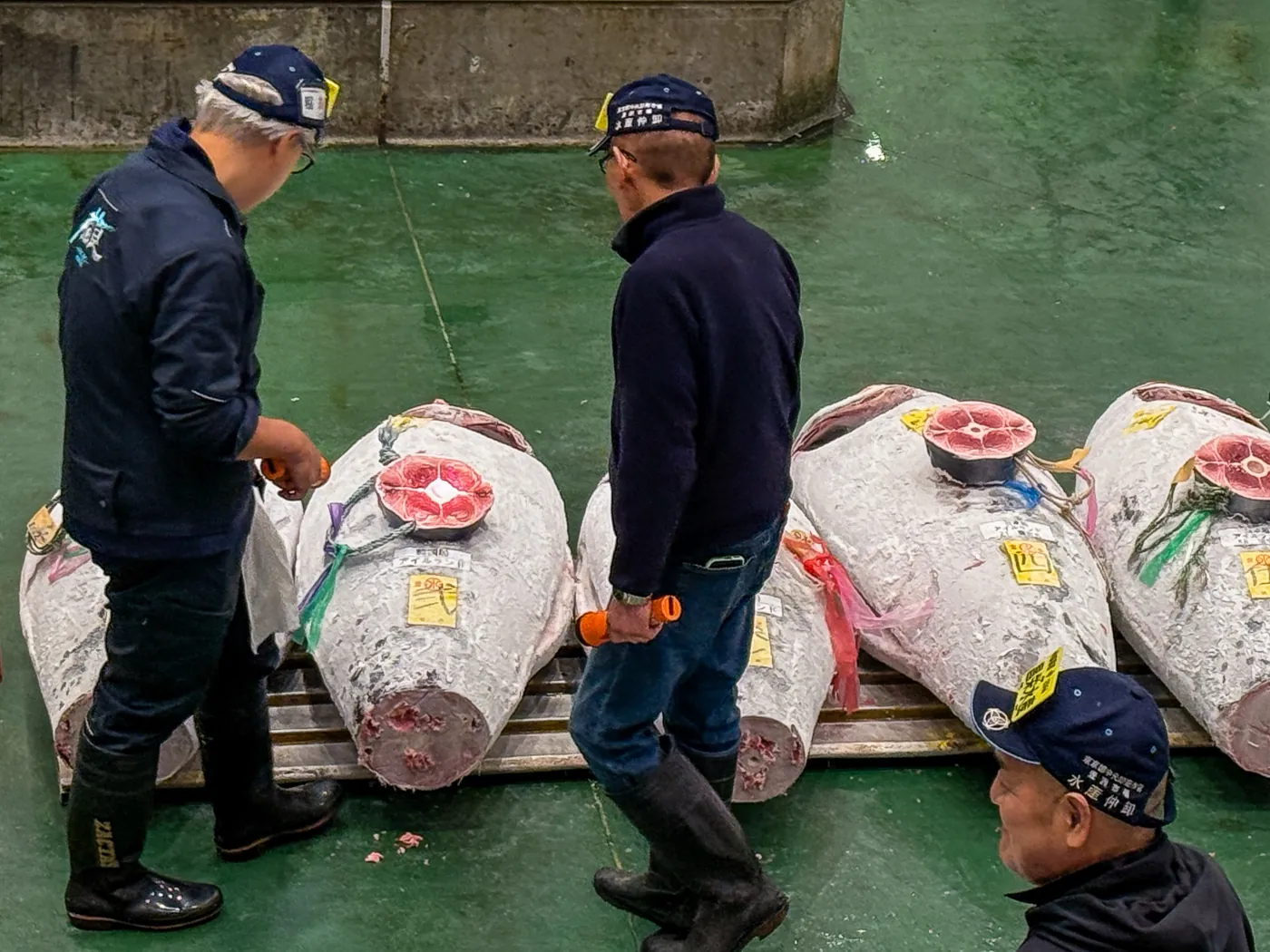
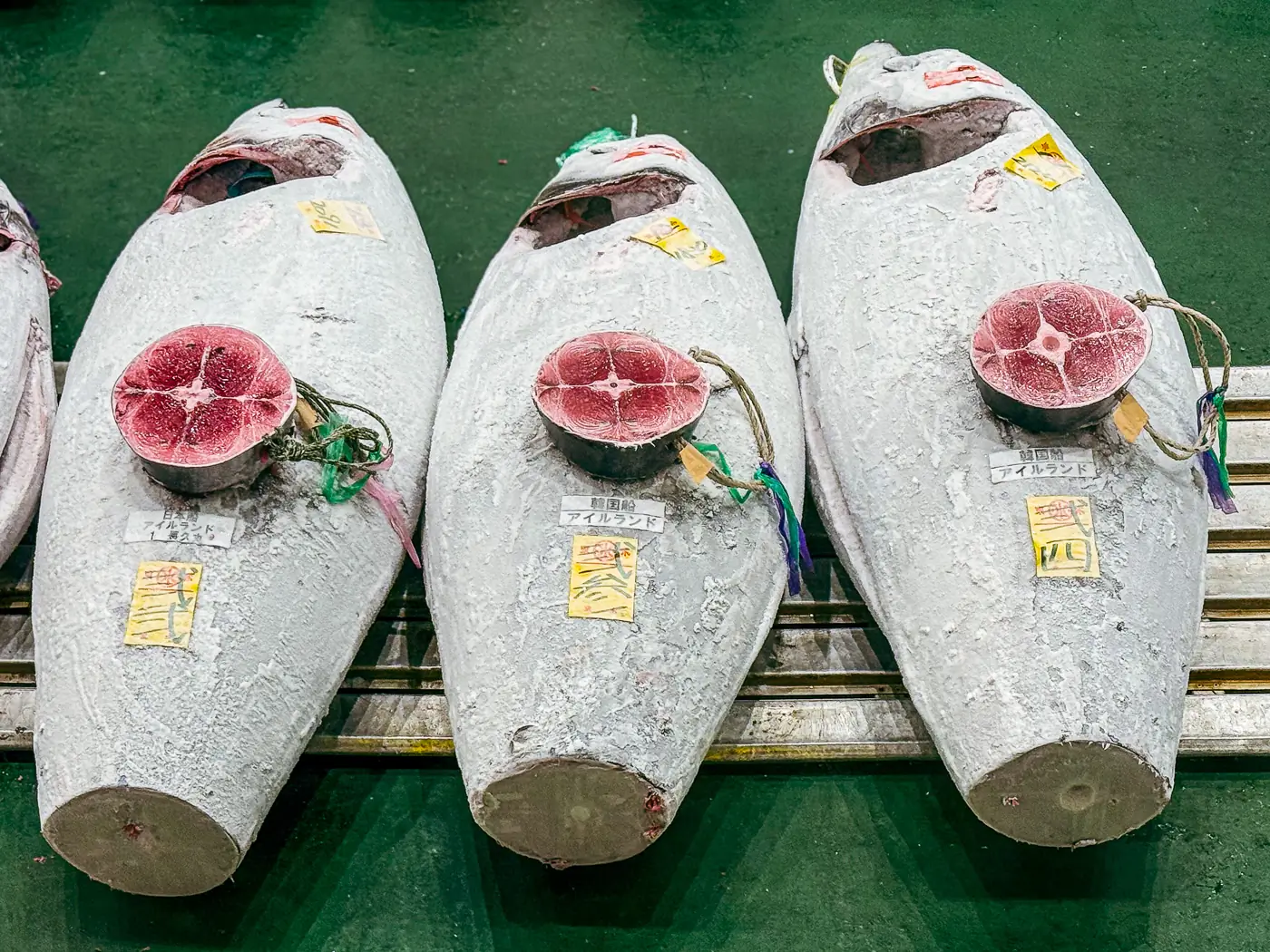
When inspecting tuna, buyers take a multifaceted approach, but as experts, they also rely heavily on intuition. Each fish is labelled with its weight, origin, the name of the fishing boat, and the fishing method.
Buyers assess tuna quality by:
- Using a pick-like tool to feel texture, extract small samples, and open parts of the flesh
- Examining the cut cross-sections of the tail and exposed belly using torches to assess colour and fat content
- Lifting and handling the tail to gauge firmness and fat
- Looking for burn marks inside and outside the fish, which indicate how much it struggled when caught
Shinoda Takayuki, an intermediate wholesaler specialising in tuna:
There are only so many high-grade Japanese raw hon-maguro each day. From the appearance, the exterior firmness, and the fattiness of the belly I can recognize the quality instinctively. It’s hard for me to explain the standards I use—really, it’s intuition.
— Shinoda Takayuki – Toyosu Market: Auction Battleground for the World’s Top Tuna (Nippon.com)
Two Ways to Watch the Toyosu Tuna Auction
There are two ways to watch the Toyosu tuna auction, which takes place early in the morning between 5.30am and 6.30am, but the names used for each aren’t always consistent. For clarity, I’ll refer to them here as:
- Observation Deck – a closer view of the auction floor that requires entering a lottery
- Public Viewing Windows – an elevated, more distant view with open access for everyone
Both options let you watch the same auction unfold on the floor below. The difference lies in how close you are to the action and whether access is restricted or open to everyone.
I’ve watched it from both views on more than one occasion and recommend them both. They’re different experiences, though, and much comes down to how much you want to see it up close and whether you wish to do the additional planning and organisation.
To help you understand the difference between watching the auction from the lottery-winning observation deck and the public viewing windows, I’ve labelled every photo on this page with the location where I took it. All images are my own, and some are cropped or zoomed for clarity.
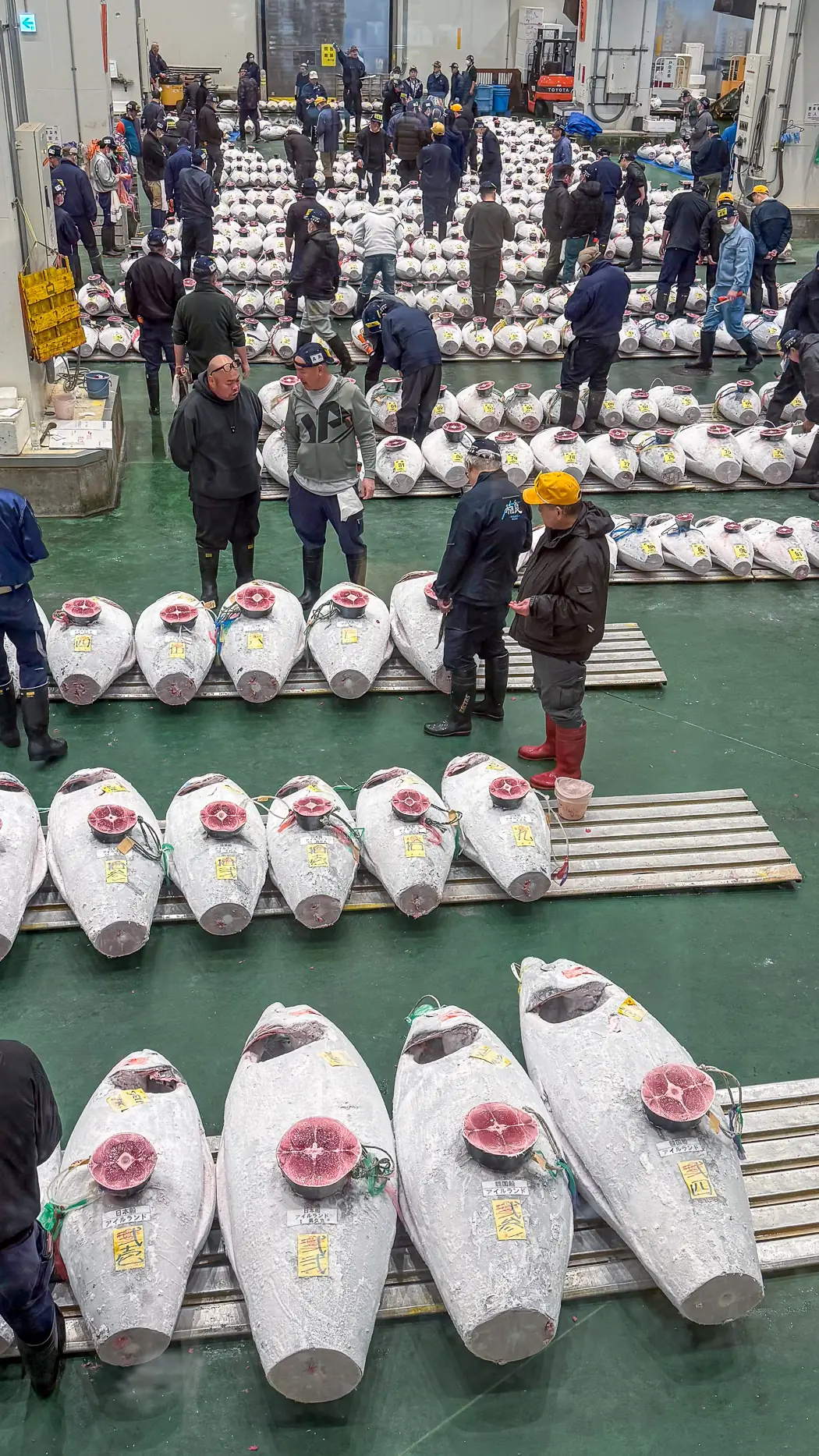
Observation Deck – Closer View (Lottery Entry Required)
To see the tuna auction up close from the observation deck, you must enter a free lottery. Viewing itself is also free, but space is limited.
Position relative to the auction floor
The observation deck sits on a mezzanine-like level just above the auction floor, offering a clear view across the tuna auction area.
From this position, you can follow specific activity on the auction floor, such as the tuna inspection and bidding, while still taking in the wider scene. It feels close enough to see what’s happening at floor level, but broad enough to appreciate the scale of the auction as a whole.
A glass screen, around 2 metres (6.5ft) high, and a railing separate the observation deck from the auction floor.
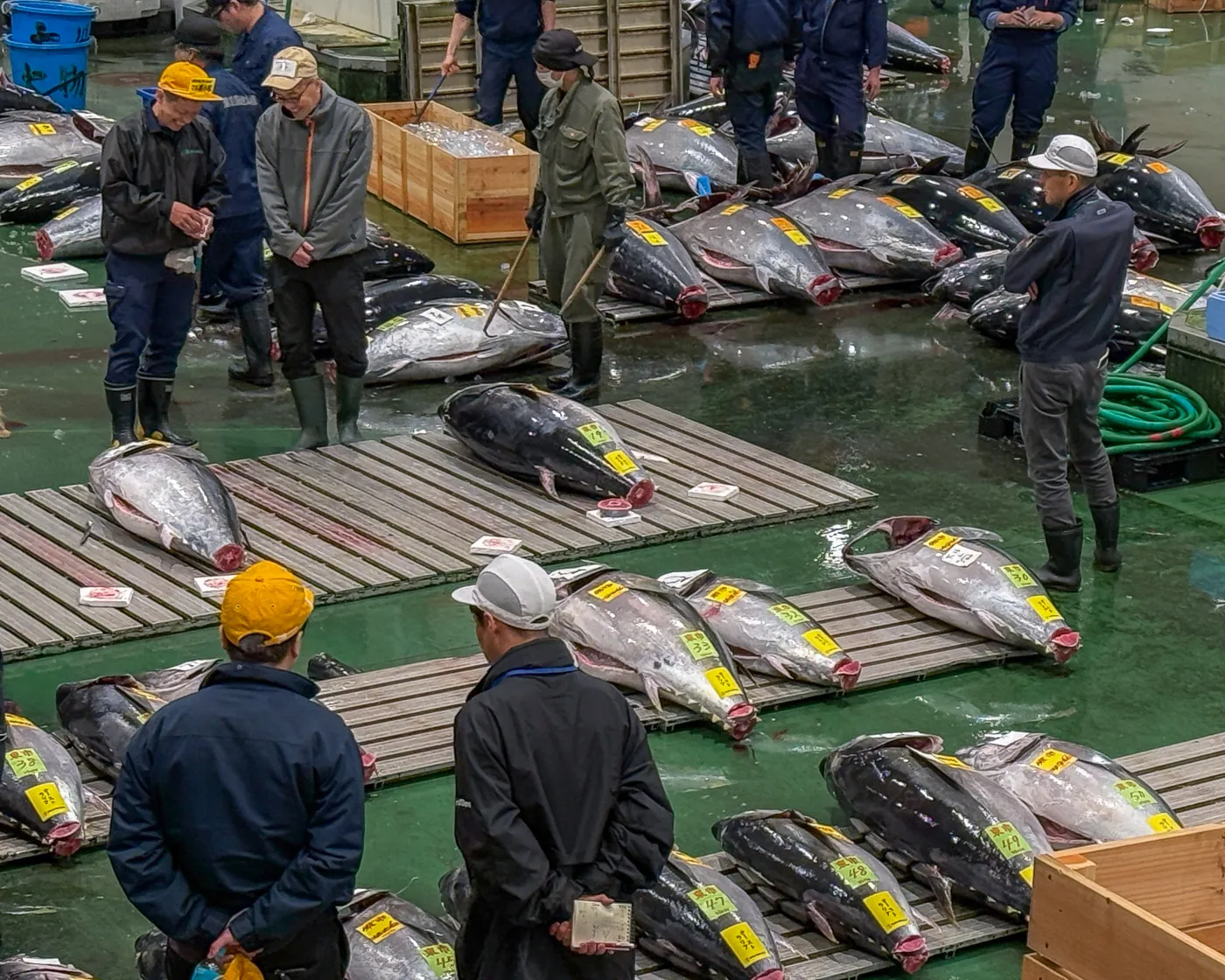
What you can see from the observation deck
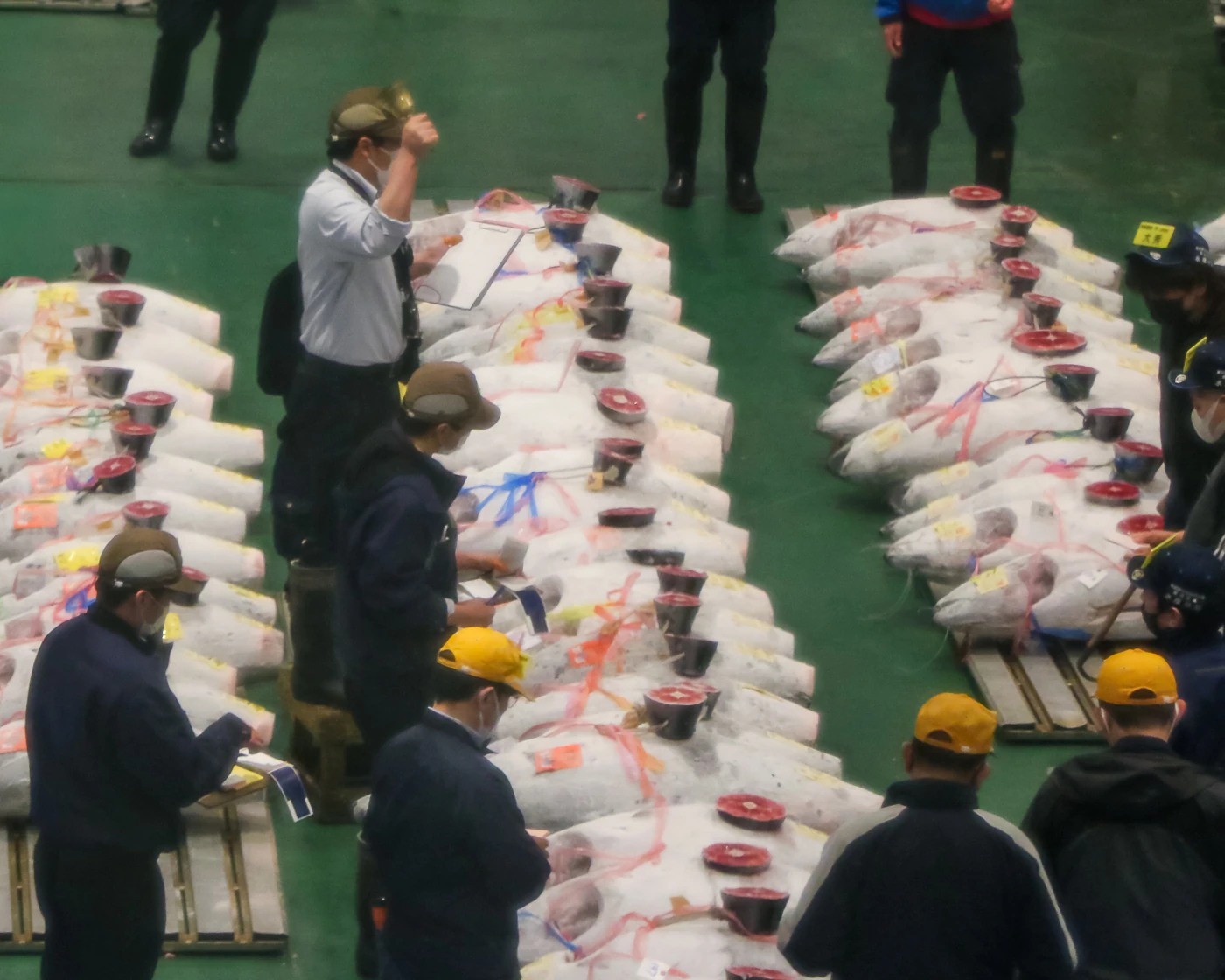
What immediately stands out from the observation deck is the sight of the fresh tuna laid out on the auction floor, their black-and-silver skins glistening under the lights. Buyers and staff move among the fish, and seeing this at such close range is striking and not something you experience from the public viewing windows.
Seeing so many fresh tuna caught off Japanese waters together, before they leave the market floor, is something few visitors ever get this close to.
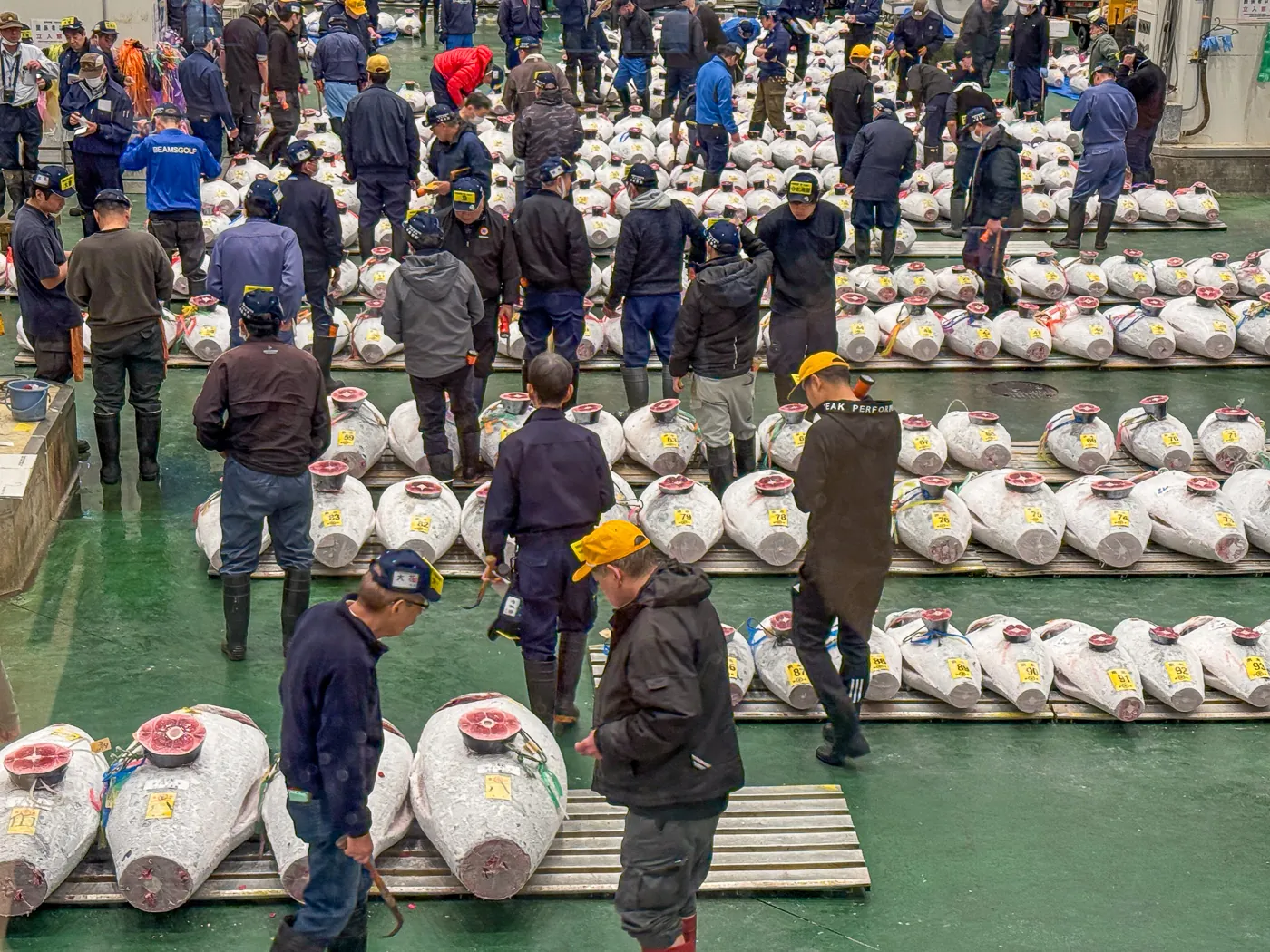
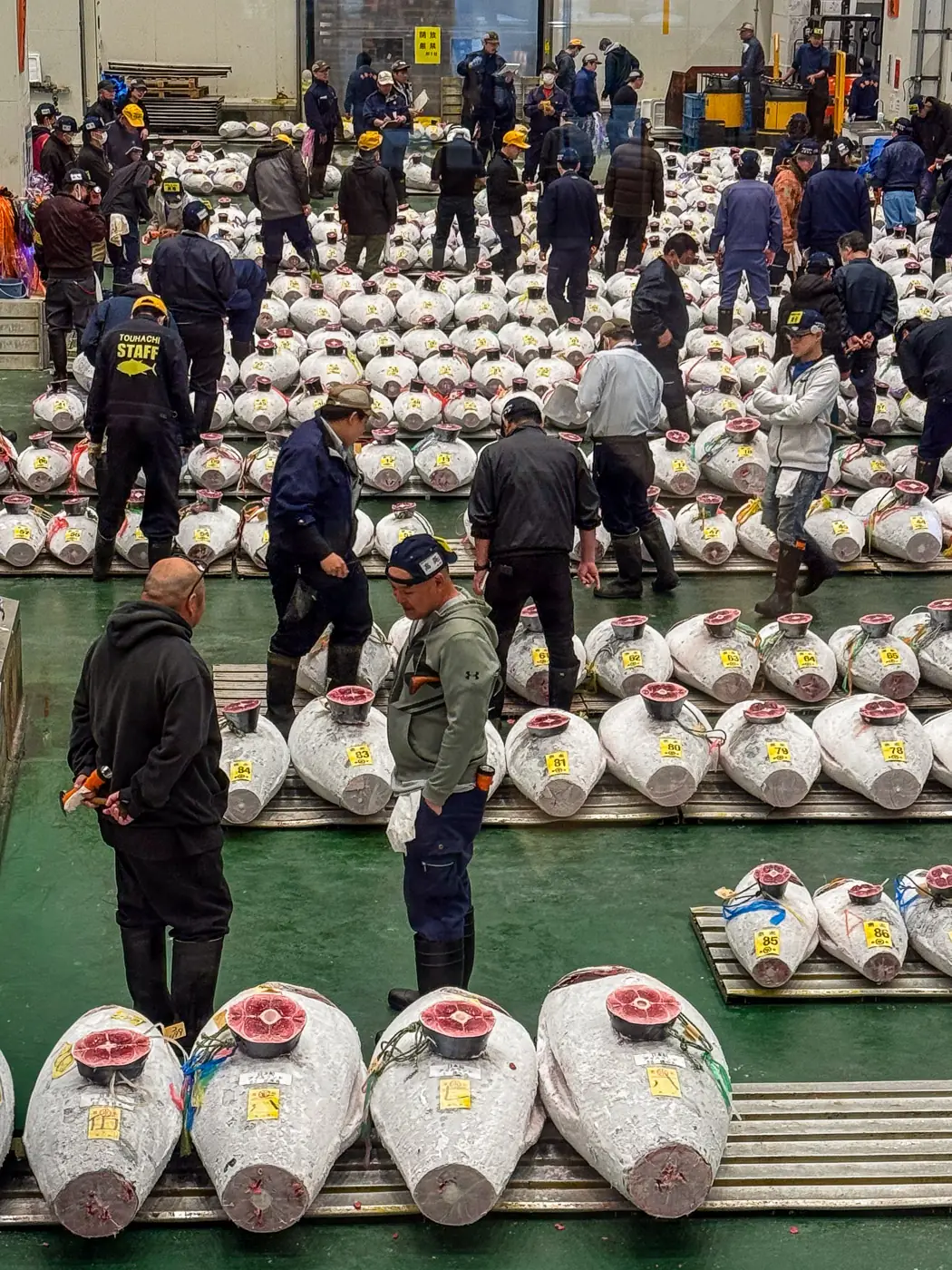
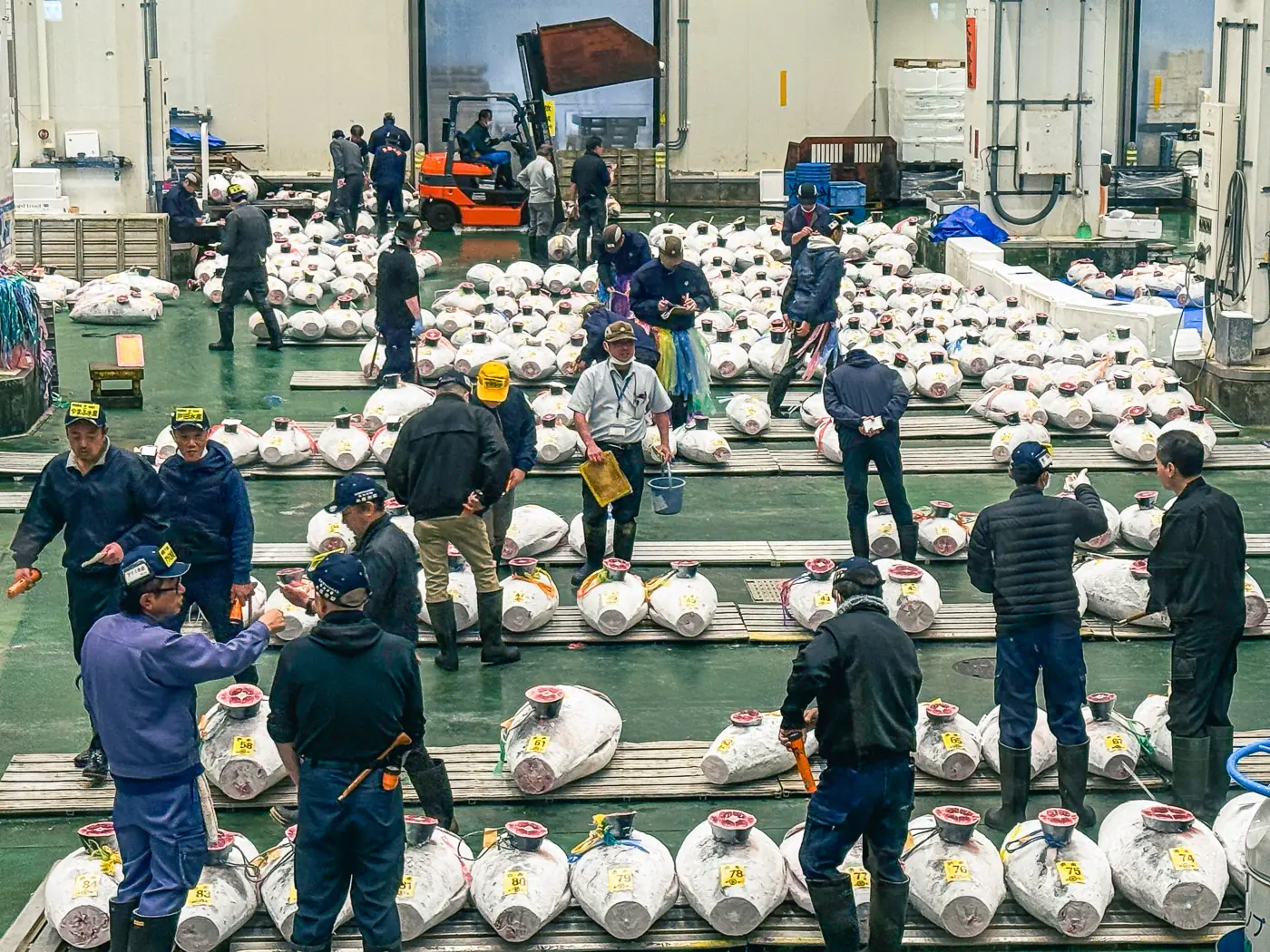
The main event, however, takes place around the frozen tuna, where you’re looking straight at the action. You get to see the inspection and auctions up close, and this is where the experience really comes alive.
In front of you, it feels relatively calm as buyers inspect the tuna with torches and pick-like hand tools. I could see some buyers deep in conversation, quietly weighing their decisions, while others seemed more jovial, chatting and exchanging knowing looks.
Meanwhile, in the background, there is a constant hum of movement among a sea of frozen tuna and people. The auctions come thick and fast, with the bell ringing out each time a new one begins.
As the auctions move closer to the observation deck, last-minute inspections increase, and the auctioneer comes clearly into view, commanding proceedings from his wooden box.
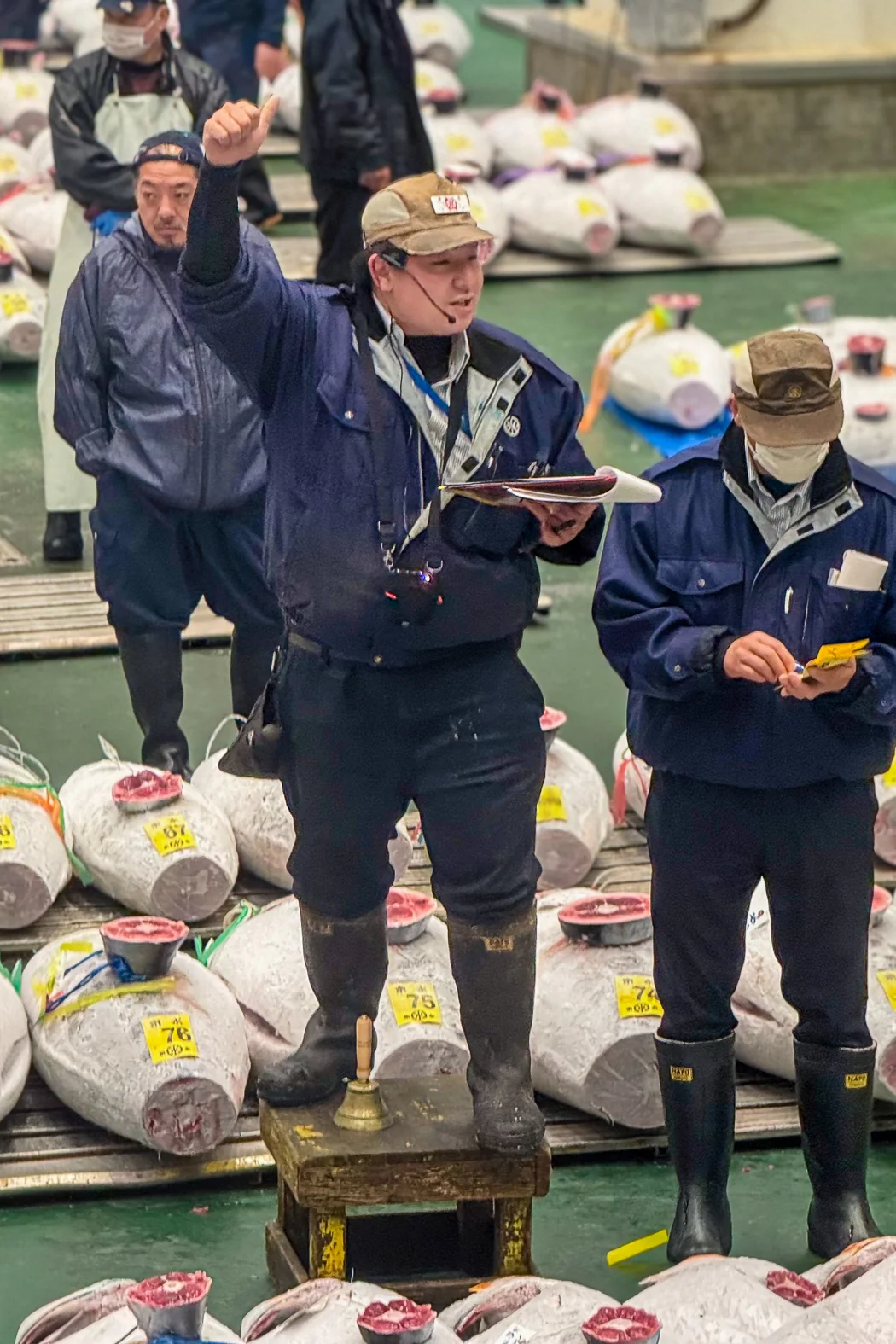
Finally, the auction is right in front of the observation deck, with the auctioneer facing directly towards you. I enjoyed this finale immensely from the deck’s grandstand view.
The auctioneer alternates between shouting with his hand raised and pointing at buyers who are making hand signals. It all happens so quickly that it’s easy to miss.
All around, there’s a constant hubbub of activity — tuna being inspected and auctioned, then tagged by workers, lifted, and wheeled away.
From the observation deck, the auction floor feels less like a market and more like a carefully choreographed performance.
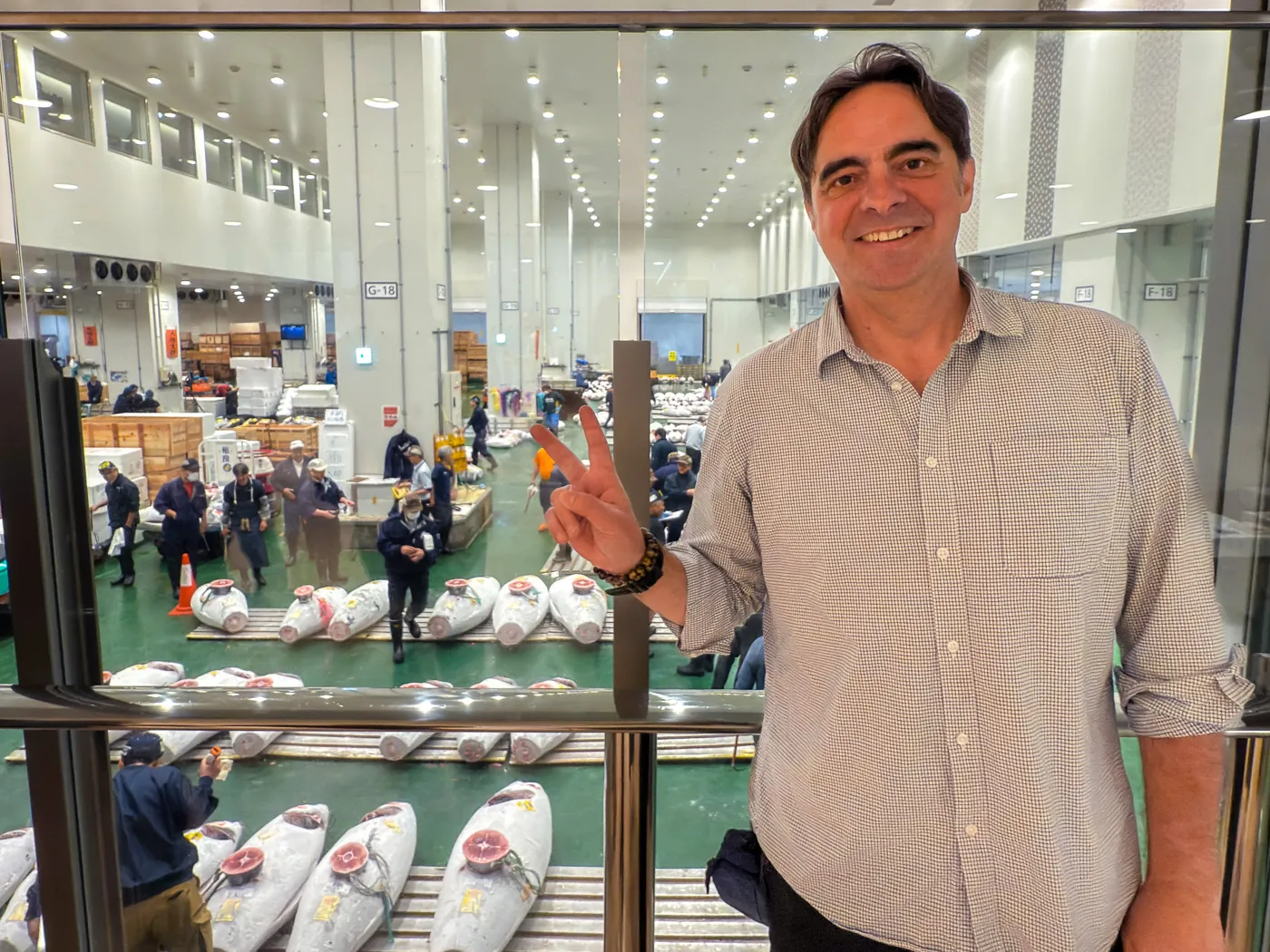
The overall experience
After wanting to experience the tuna auction from the observation deck for so long, I was genuinely in awe of finally being there.
I focused on being there in the moment, switching my attention between smaller scenes and the whole canvas. Throughout, there was a clear juxtaposition between the hustle and bustle of the market and its calm, orderly progression, in a way that felt distinctly Japanese and familiar.
There was plenty of commentary around me. Still, for my first visit, I wanted to experience it quietly, observing the auction floor for myself. At times, that commentary carried across the deck, softening the sounds from below — the rhythmic ringing of the bell and the low murmur of voices.
I was deeply impressed by what I experienced, and it more than lived up to it.
Overall, it’s an experience I’d strongly recommend, and one that easily justifies the early start and extra planning required to see it from the observation deck.
On the day of the auction
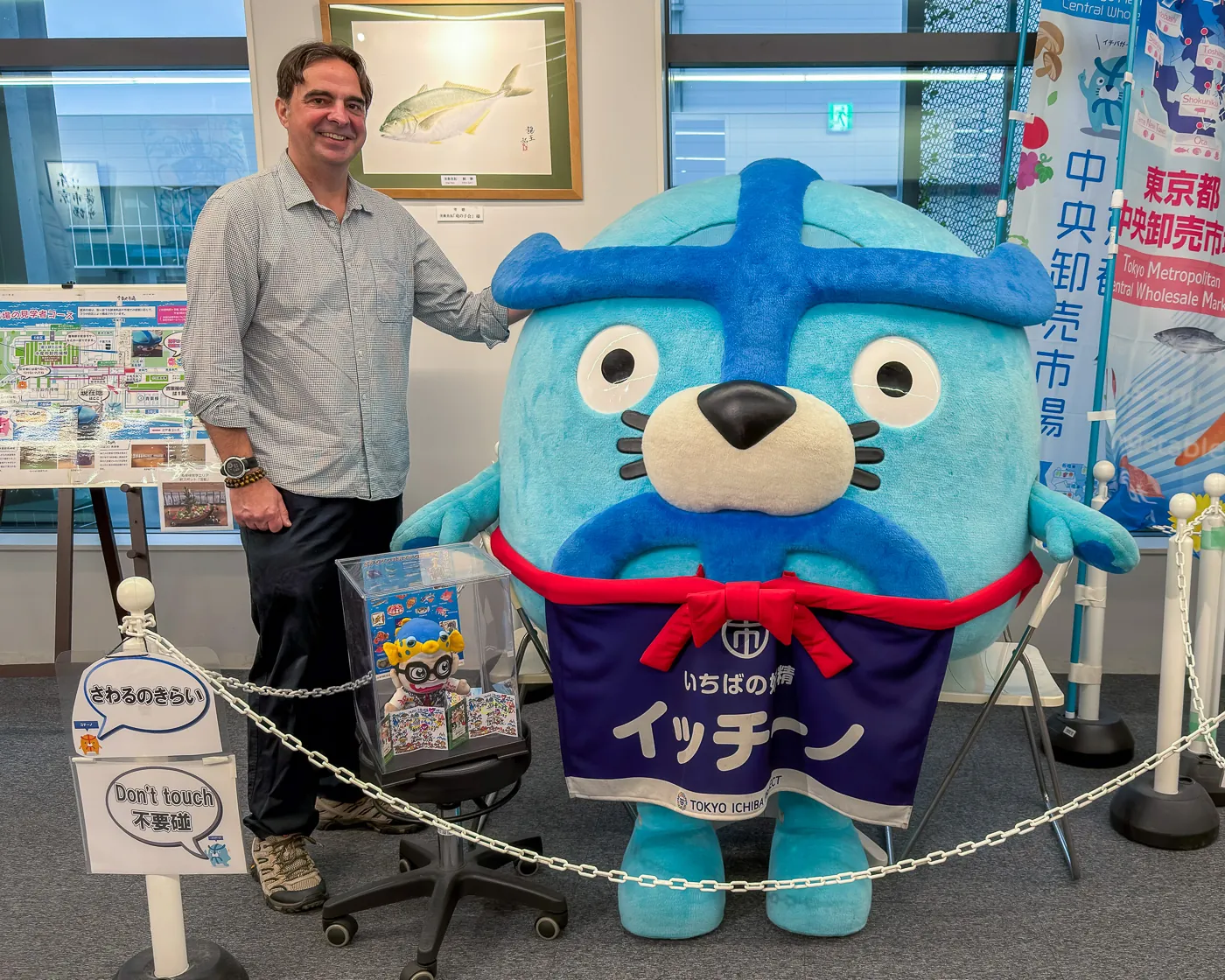
Lottery winners must arrive at the Promotional Corner in Toyosu Market by 5.30am. I recommend arriving at least 15 minutes earlier to allow time to get there comfortably. The route is clearly signposted, and you’ll pass the large tuna display on the way.
When you arrive, the staff verify your name and ID. I’d saved a screenshot of my winning confirmation, but it wasn’t necessary. After verification, you’ll receive a paper ticket and be allocated a place in the queue.
The system assigns queue positions on a first-come, first-served basis, so arriving early does offer a slight advantage. With up to 100 people on the deck, not everyone can stand at the front at once, but there was plenty of time to rotate and get a clear view.
When they’re ready, staff escort the group to the tuna auction observation deck in a typically orderly Japanese fashion.
I recommend bringing an extra layer of clothing, or two if you feel the cold. I had a t-shirt and a lightweight fleece jacket on, and didn’t feel chilly at all.
Flash photography is not allowed, but you don’t need it anyway, as the auction floor is very bright. Keep in mind there’s a glass screen in front of you, which can affect photos and videos.
The observation deck experience lasts for around 45 minutes, so there’s plenty of time to enjoy it.
Drawbacks of the observation deck
There are no significant drawbacks, and certainly nothing that detracted from my overall experience. That said, there were a couple of minor points worth noting.
The observation deck isn’t large enough for everyone to have an uninterrupted view at all times. Taller visitors tend to have fewer issues, while shorter visitors may need to be a little more proactive, as not everyone is quick to step aside once they reach the front.
Another minor drawback is that some guided explanations on the observation deck can be pretty loud. I wasn’t sure whether these came from market staff or organised tour groups, but at times the volume took a little away from the experience.
Public Viewing Windows – Elevated, Distant View (No Lottery Required)
To see the tuna auction from the public viewing windows, it’s free to visit, there’s no lottery to enter, and you can turn up on the day.
Position relative to the auction floor
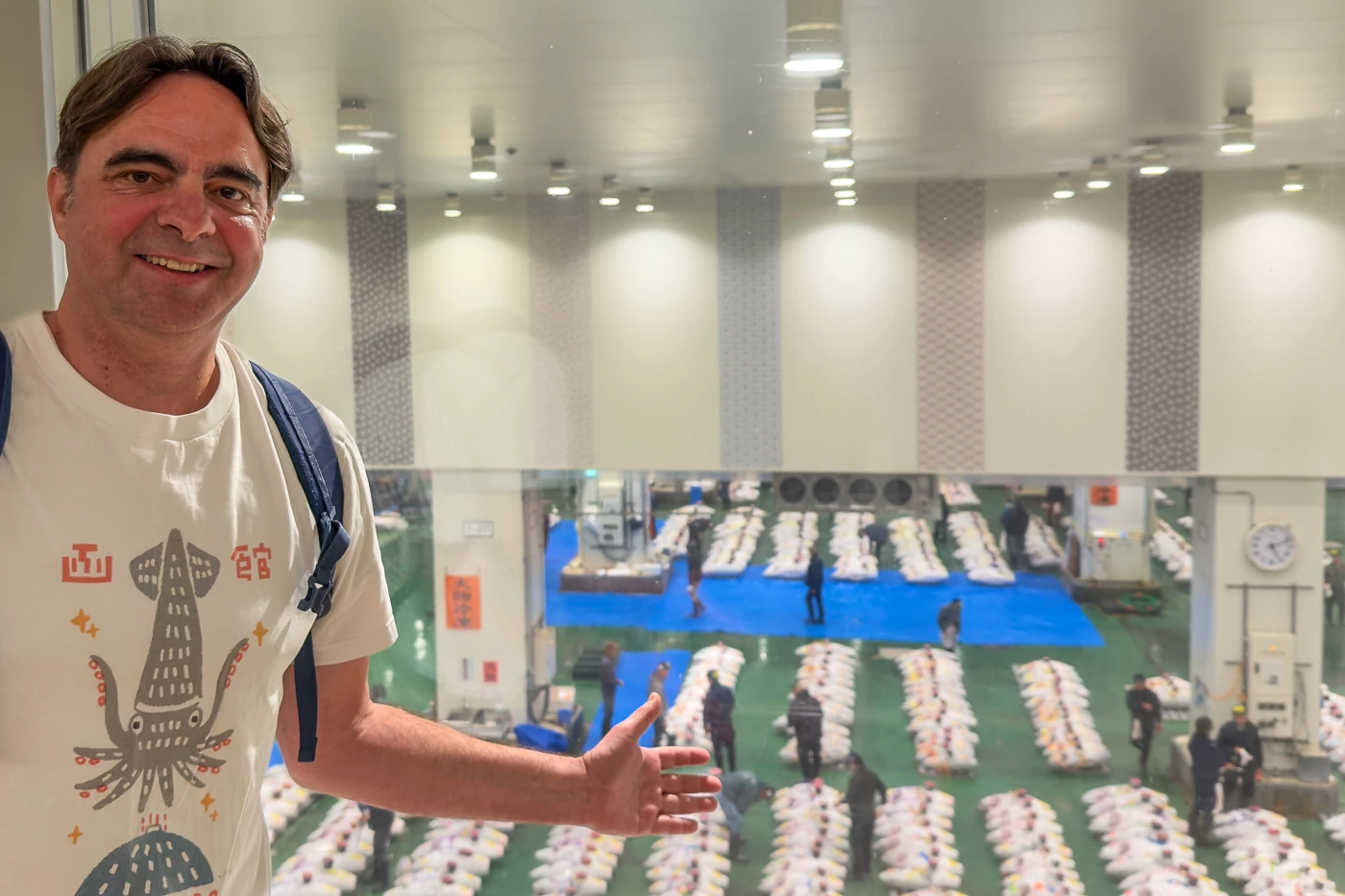
The public viewing windows are several levels above the auction floor, giving a distant, top-down view of the action below.
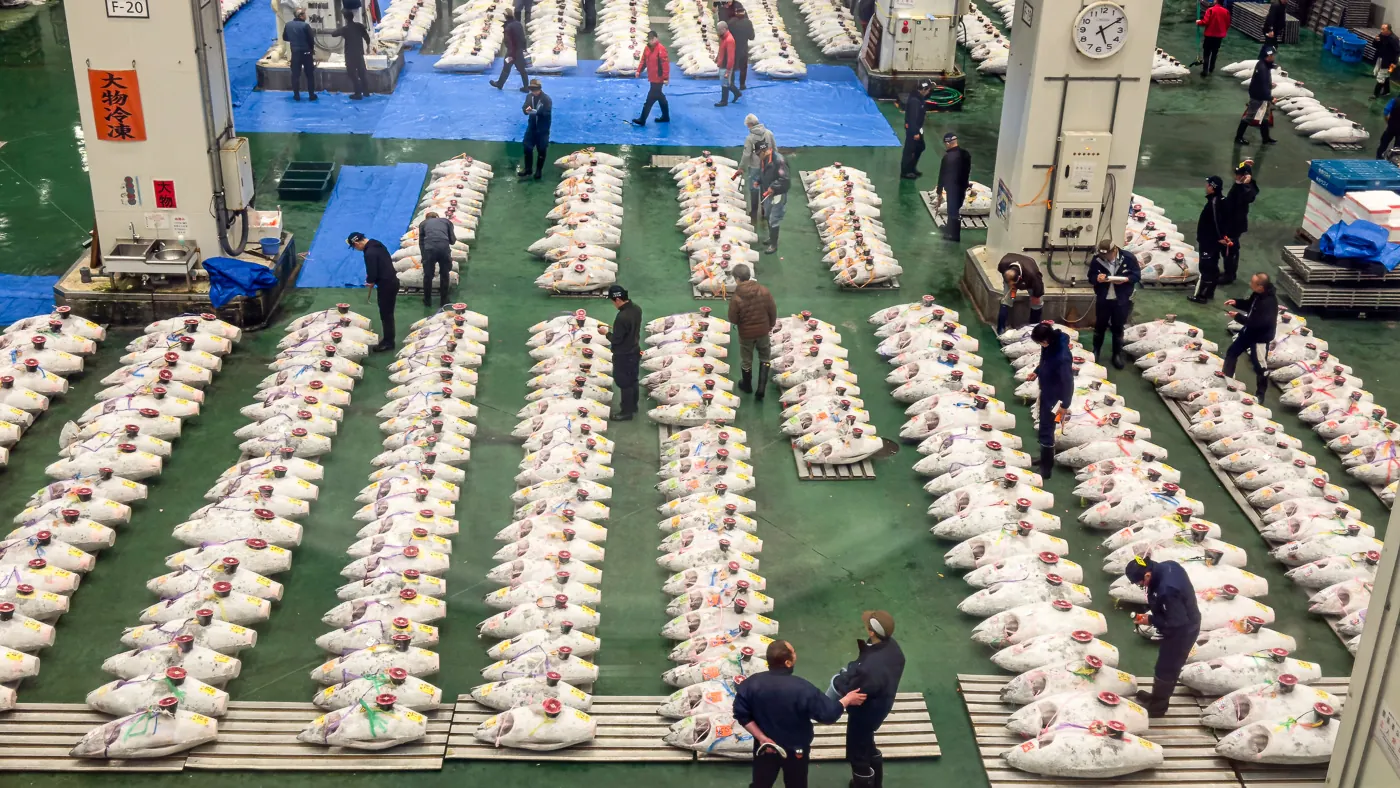
From this elevated position, you get a wide, panoramic view of the auction floor, particularly the frozen tuna, making it easy to follow the auction as a whole rather than the fine detail.
A continuous run of large windows lines one side of a long corridor, with pillars taking up around 15% of the view.
What you can see from the public viewing windows
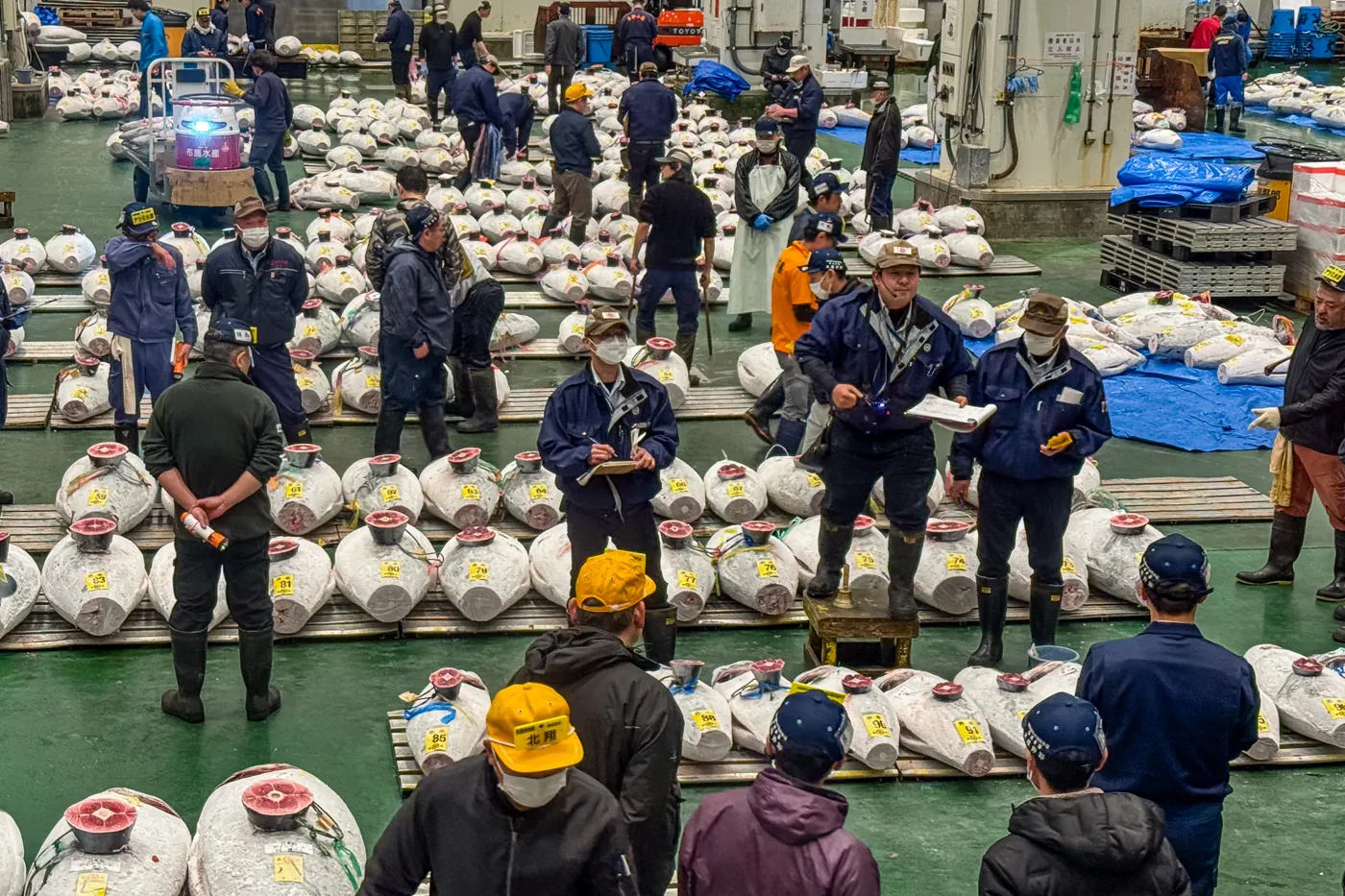
The public viewing windows are ideal for seeing the tuna, and it’s clear the designers created them with this in mind. It’s a grand spectacle to see neat row upon row of frozen tuna, and you immediately get a sense of the sheer scale of the operation.
From the elevated position looking down, it’s easy to follow the flow of activity, from tuna inspections to auctions and on to tagging and packing. The wide angle means you can observe each stage of the process at any given time.
I watched attentively as the buyers methodically conducted the tuna inspections, moving down the rows one by one. From above, it’s very clear to see them shining torches on the cut-off tail sections and jabbing the tail-end flesh with their pick-like tools.
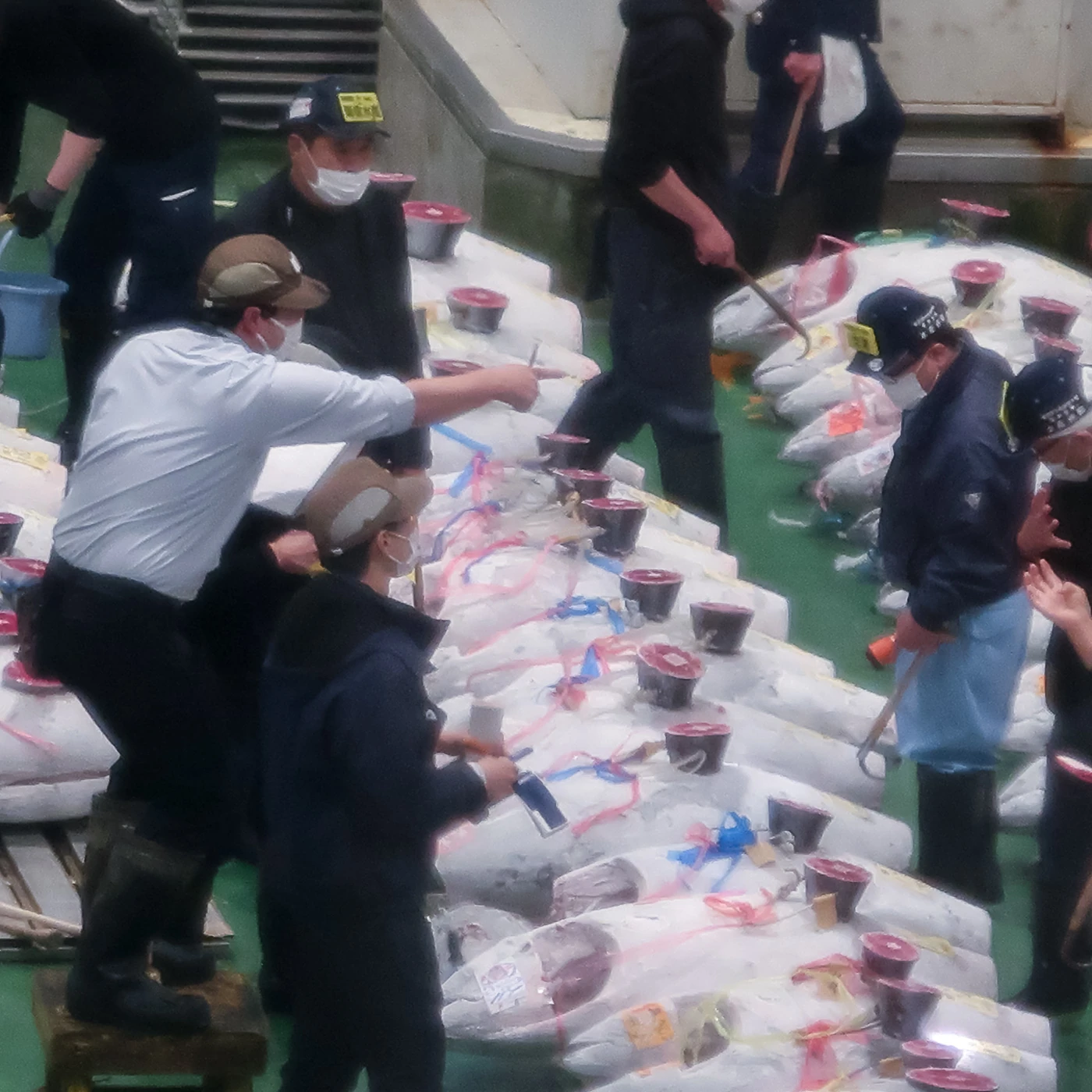
Seeing the auctions from a side view gives you an excellent view of the auctioneer’s posture and gestures, from ringing the bell to raising his arm and pointing at buyers. I tried to follow the buyers’ signals, but with people milling around inspecting tuna, it’s not always clear exactly which tuna the auctioneers are auctioning or who is bidding.
Fine details can be challenging to pick out, but the auction’s overall rhythm and flow are unmistakable.
From the public viewing windows, you get a panoramic, step-by-step view of the frozen tuna auction, one that’s less about individual moments and more about the scale and coordination of the whole operation.
The overall experience
On my first visit to Toyosu Market, watching the tuna auction was a must-do, and I loved every minute of it.
When I’ve attended, I get to the public viewing windows just after 5.00am, which gives plenty of time to watch the frozen tuna inspections. At that time, there are only a few other people around, so you can choose almost any spot.
Even when more people arrive later, it’s still easy to find a space at the windows.
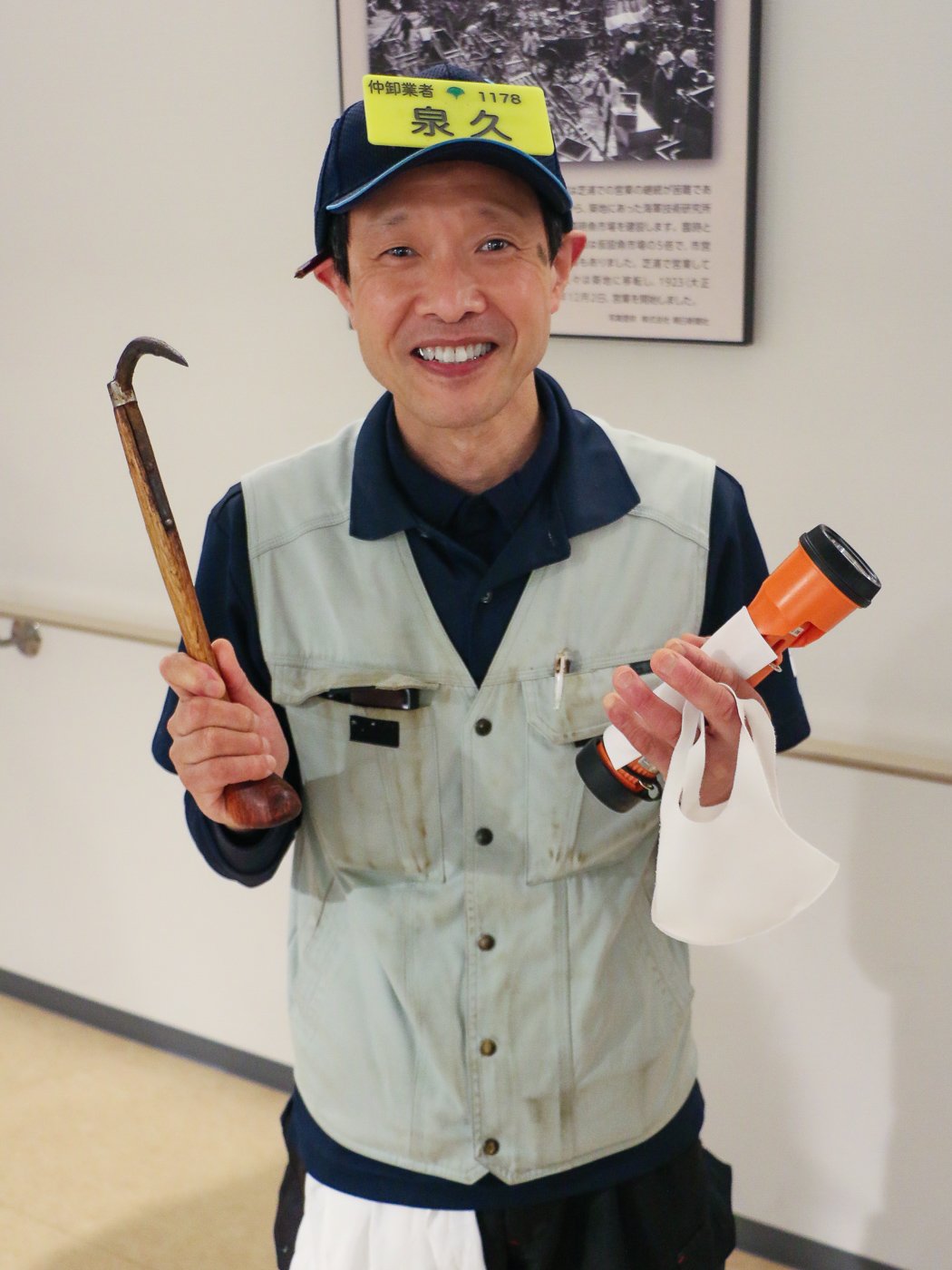
On one visit, a buyer from Izukyu, a Japanese seafood wholesaler, arrived early and explained some of what was happening, even demonstrating an inspection tool. I don’t know whether this was official or a one-off, but it was genuinely helpful.
Since my first visit, speakers have been added along the corridor, relaying audio from the auction floor. It’s a welcome addition that noticeably improves the atmosphere.
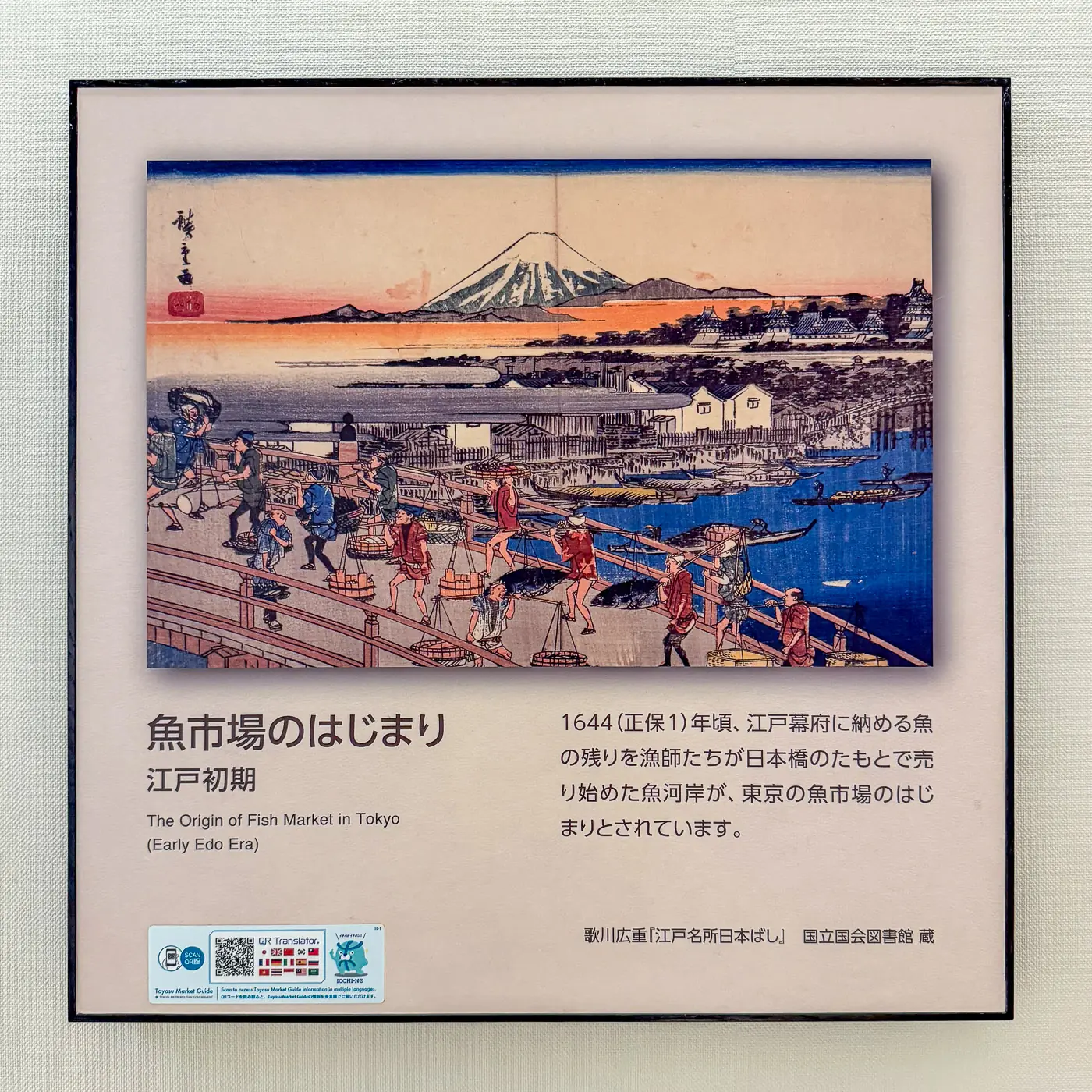
Along the corridor, images trace the history of Tokyo’s fish market from nearly 400 years ago through to Tsukiji. There’s also a board that explains the numbered hand signals used by buyers, adding helpful context and depth to the experience.
Independence is a significant advantage here. You’re free to come and go without a fixed time slot and make the most of the early start when the market opens.
Overall, the public viewing windows feel calm and unhurried, and more observational than immersive. I highly recommend watching the auction from here.
On the day of the auction
The public viewing windows open at 5am, when the market opens. It takes about 5–10 minutes to walk there from the market entrance.
The area is open to the public free of charge, with no booking required. Visitor numbers can vary by day, season, and arrival time, which can affect how easy it is to find a clear viewing spot.
As I’ve already mentioned — but it’s worth stressing — getting there as soon as the market opens has worked best for me. The quieter atmosphere feels more personal and gives you time to get orientated.
On a practical level, it means more time spent watching the tuna inspection and deciding where to stand first. The best spot is in the middle of the tuna as you face them, which gives the best overall view.
There are no seats, so you’ll be standing throughout, but it’s easy to move around and adjust your position.
If the opening time puts you off, or if you’re running late, getting there around 6am, mid-auction, is still enough to see the inspections, the auction, and the packing. On my visits, you’d still have had a good view at that time.
The public viewing windows are open all day. Tuna packing continues beyond the auction, and there was still activity when I took my last photo at 7.20am.
Drawbacks of the public viewing windows
There are no showstopper drawbacks for me, but there are a few practical points to be aware of.
The public viewing windows are several levels above the auction floor. You can see everything, but only from a distance, not up close.
I didn’t really notice it at the time, but looking back at my photos, the view from the public viewing windows is slightly hazy. The thick glass and the temperature difference between the viewing area and the auction floor seem to contribute to this.
That’s also partly down to me not knowing how to get the best out of my DSLR camera! On a more serious note, even keen photographers and videographers will find it harder to get clean, sharp images from here.
How to Enter the Tuna Auction Lottery
At its simplest, the tuna auction lottery process works like this:
- Apply during the designated application period, around one month before you want to attend
- Check whether you’ve secured a ticket, typically 1–2 weeks after applying
- Attend the tuna auction on the assigned date
Key points about the lottery
Here are some key things to know about the tuna auction lottery.
Free of charge
The tuna auction lottery is free to enter, and you won’t pay anything on the day to view the auction up close from the observation deck.
A note on manners
Please enter the lottery only if you genuinely intend to attend, and take a moment to consider whether you’re able and willing to arrive at Toyosu Market by 5:15am.
Lottery entry and observation deck access are free, and the system operates on a trust basis, allowing visitors to enjoy this experience. Failing to attend after winning a place prevents others from participating and wastes the time and effort of Toyosu Market’s administrators.
Number of applicants
Each application can include up to five people. Groups of six or more must submit at least two separate applications. All children, including newborn babies, count as one applicant.
Choice of dates
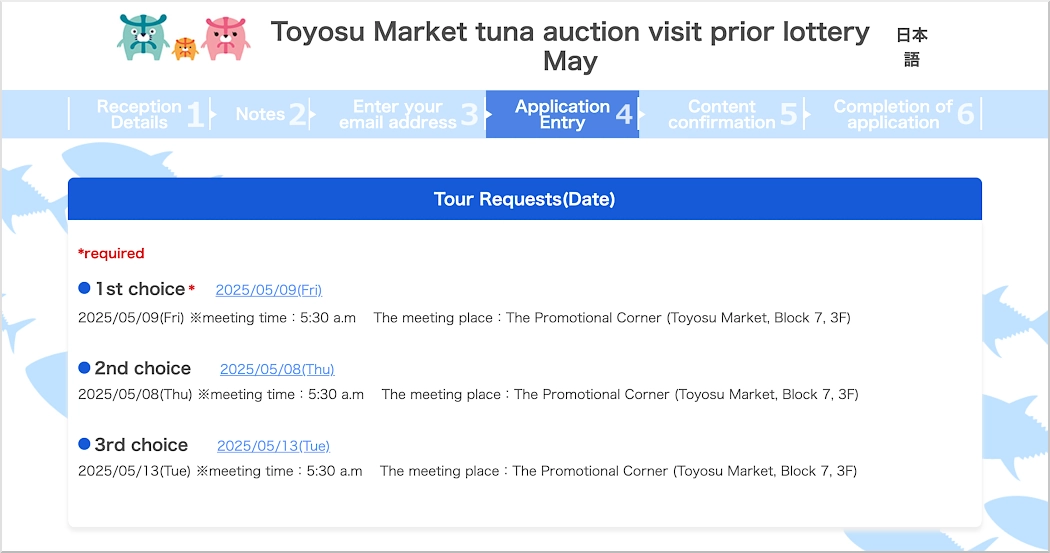
You can apply for up to three dates per application.
Days of operation
The market holds the tuna auction on most Mondays, Tuesdays, Thursdays, Fridays, and Saturdays. It closes on most Wednesdays and Sundays.
There are exceptions, including closures on most Japanese public holidays and during the year-end period from 25 December to 5 January.
Only dates on which the auction operates will be available to select during the lottery process.
Can you turn up on the day?
No. It is not possible to turn up on the day without a winning lottery entry. Only lottery winners, verified with their passport or ID, are permitted to view the tuna auction from the observation deck.
Change to dates or attendees
Once the application window has closed and the lottery has been completed, you cannot change the selected dates or the names of people attending.
Lottery winners
Each day, 100 lottery winners are selected to watch the tuna auction from the observation deck.
Arrival time and late arrivals
The meeting point time is 5:30am; however, I recommend arriving by 5:15am. You should also allow around 15 minutes to find the correct location when you get to the market, which is clearly signposted.
If you arrive late at the meeting point, you will not be permitted access to the observation deck.
Planning tip for longer trips
If your trip to Japan spans two calendar months, you can enter the tuna auction lottery in both months, as applications are tied to the month you’re applying for rather than the length of your stay.
This approach doesn’t guarantee success, but it does give you more chances if your dates are flexible.
Tuna Auction Lottery: Step-by-Step Instructions and Guidance
I’ll explain how the tuna auction lottery process works, using real examples from my own experience.
1. To apply, go to the dedicated tuna auction lottery website
Use the official ‘Toyosu Market tuna auction visit prior lottery’ website.
The application window opens for one week in the month before you’d like to attend. In my case, I wanted to visit in May 2025, with the application window running from 2–8 April 2025.
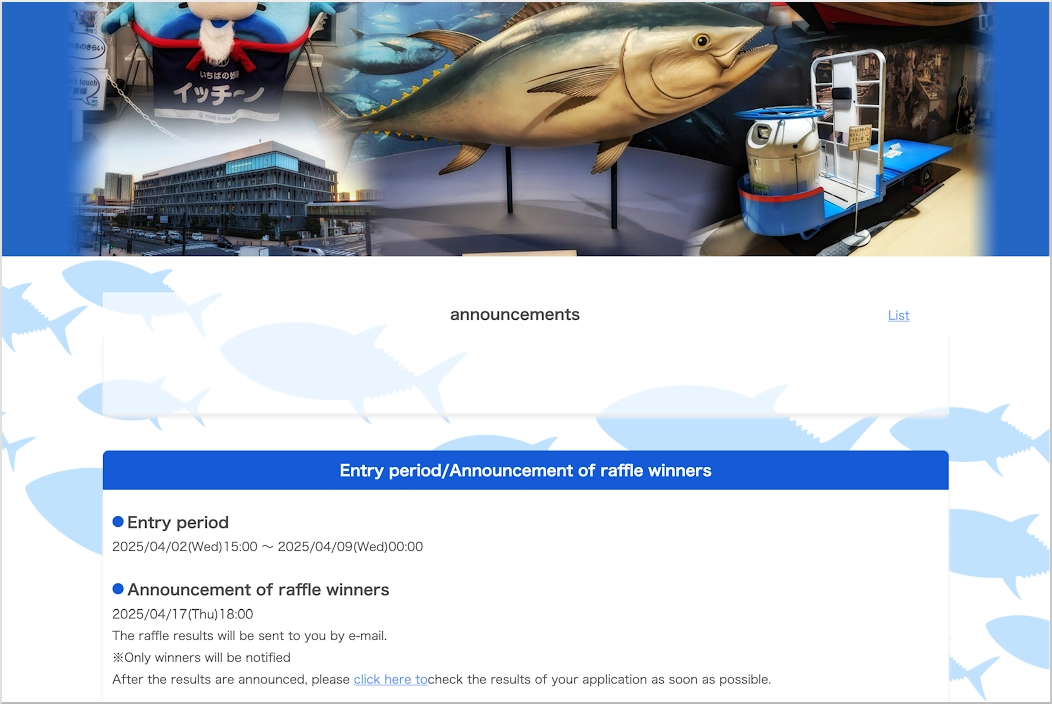
You can find a complete list of dates and application windows on the official Toyosu tuna auction lottery calendar.
The next page in the application process outlines the lottery terms and conditions, along with additional notes.
2. Email address confirmation
The next step is to enter and confirm your email address. You’ll then receive an email containing a link to complete the application form.
3. Application form
The application form has two sections:
- Tour request dates
- Customer information
Tour request dates
Select up to three dates you’re interested in from the available options.
Customer information
Complete the following information:
- Your name – first name(s) and family name, as shown on your passport or ID
- Date of birth
- Country of residence
- Password – required to log in and view your results
- Number of applicants – up to five people per application
4. Submit your application
After confirming that your application details are correct, submit your application.
You’ll then receive a confirmation email titled ‘Application Completion Notice’, confirming that you have submitted your application.
Until the application window closes, you can amend your selected dates.
5. Announcement of Lottery Results
On the day we announce the lottery results, you’ll receive an email titled ‘Announcement of Lottery Results Posting’. Use the link in the email to log in and view your results.
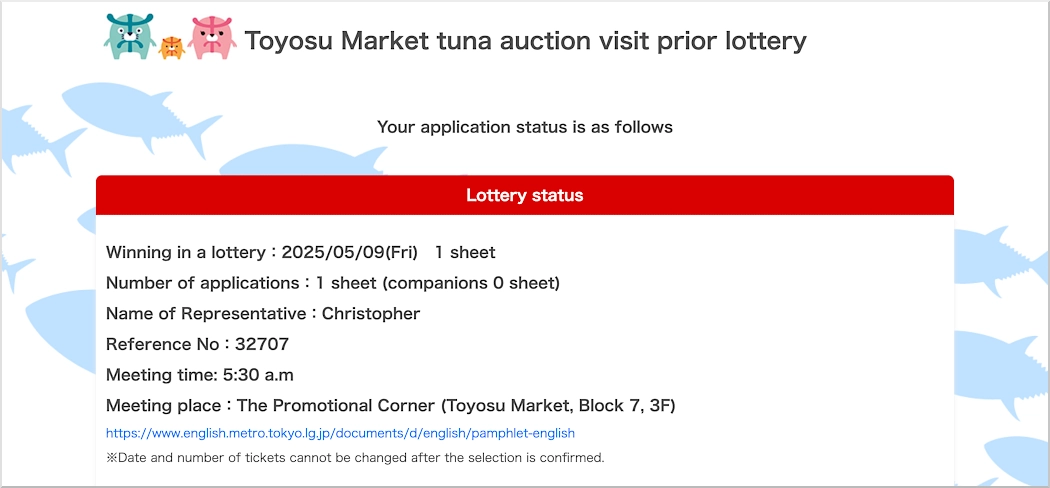
I’ve obscured my full name from the screenshot for privacy reasons.
In my case, I was fortunate enough to secure a winning ticket for my first-choice date.
Comparison: Observation Deck vs Public Viewing Windows
To help you compare the two viewing options, here’s an at-a-glance comparison.
| Observation Deck | Public Viewing Windows |
|
|---|---|---|
| Access | Lottery entry required | Open to the public (no lottery required) |
| Cost | Free | Free |
| Start time | 5.30am | 5am (market opens) |
| Viewing time | 1 hour (approx) | No limit |
| Capacity | Approx. 100 | Not capped |
| Freedom | Fixed time slot | Come and go freely |
| View height | 1 floor * (approx) | 3 floors * (approx) |
| Angle | Facing the auction floor | Side-on / top-down |
| Floor coverage |
Much wider (approx. x2-3 more) |
Narrower, partial view |
| Fresh tuna visible |
Visible | Not visible |
| Atmosphere | More immersive, focused | Calmer, more relaxed |
* ‘Floor(s)’ is used as a relative reference within the market building, not a standard building height
Which Option Is Right for You?
There’s no single best option for viewing the tuna auction, whether from the observation deck or the public viewing windows. If you’re still undecided, here’s some guidance based on the two.
There is also a third option where you don’t need to choose.
Get the best of both worlds
It’s possible to watch the tuna auction from both viewpoints. You can start at the public viewing windows to see the tuna inspection, then head to the Promotional Corner meeting point for the observation deck.
If you enter the market at 5am, it’s a 5–10 minute walk to the public viewing windows, and you’ll pass the Promotional Corner on the way, making it easy to return later.
I took this approach the first time I won the lottery, spending around 20 minutes at the public viewing windows before heading back to the lottery winners’ meeting point.
You also don’t have to stay on the observation deck until 6.30am. You can leave early and continue watching from the public viewing windows.
Finally, you can visit the public windows after the observation deck closes, although the auctions will have finished by then. On one occasion, I watched workers move the tuna off the floor and pack it.
Seeing the Tuna Auction on a Guided Tour
Disclosure: I was hosted on this tour by one of my partners. If you book via this link, I may earn a small commission at no extra cost to you.
I highly recommend this private guided tour of the Toyosu Market tuna auction and the Tsukiji Market experience with Emi and her team.
It’s a complete Tokyo seafood lovers’ adventure, including:
Toyosu Market
- Hotel pick-up – met me at my hotel in Tsukiji and got me to Toyosu on time
- Tuna auction – watched the auction with expert commentary and explanations
- Shopping – walk-through of Uogashi Yokocho with personalised kitchenware and souvenir suggestions
- Breakfast – recommendation of where to eat a sushi or sashimi breakfast suited to your budget
Tsukiji Market
- Outer Market – guided walk-through with recommendations on where to eat, what to buy and a local cafe
What I loved about this tour
Emi’s got a genuine passion for Japan’s seafood culture, especially tuna and Toyosu Market, which really shines through. Because I share her passion, we quickly got deep into a conversation about it.
Throughout the experience, Emi shared her deep knowledge of markets and Japan’s tuna trade, tailoring her commentary to me.
Knowing that I’d lived in Japan and my wife is Japanese, she gave me personalised shopping recommendations for buying dashi.
Emi’s tour is private and respectful of other visitors and the market workers, which made the whole experience more enjoyable.
Most importantly, she managed to squeeze me onto the observation deck, which is usually reserved for lottery winners. I don’t know if that is always the case, but it was a very welcome surprise.
Check availability with Emi’s tour
For more experiences, check out my Toyosu Market and tuna auction tours page.

Discovering washoku through travel in Japan. Sharing the best Japanese food and drink experiences. Living in Osaka. Join me on my journey!